
Neoclassicism and Industrial Revolution: Revived Classics Meets Iron-framed Factories
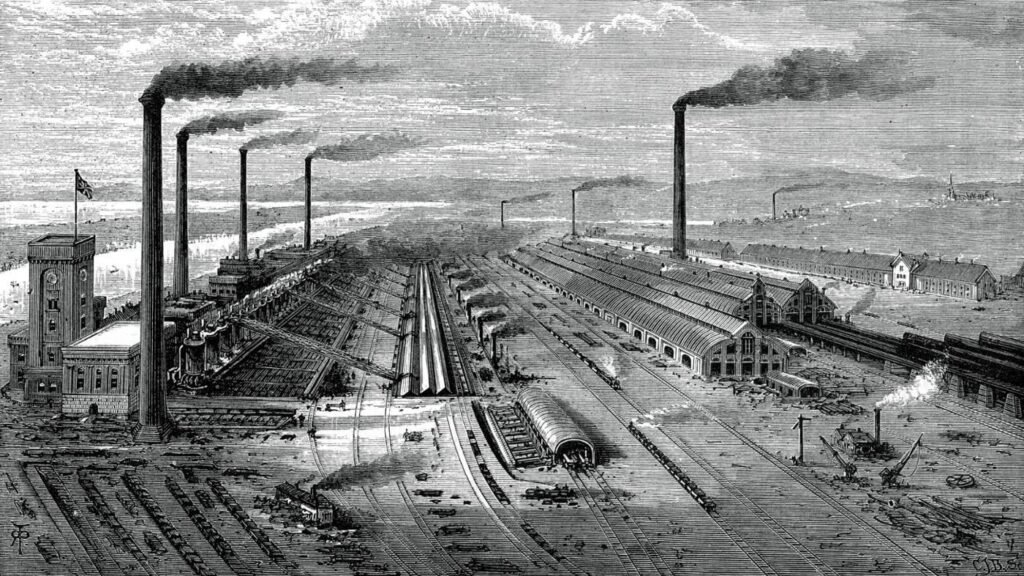
In the late 18th and 19th centuries, architecture and interior design underwent a dramatic transformation. The elegance of Neoclassicism – a revival of Greek and Roman ideals – suddenly found itself sharing the stage with the brute force of the Industrial Revolution’s iron and steam. This was a pivotal turning point in design history, where timeless classical principles collided with cutting-edge industrial technology. The result was an era of “Revived Classics” meeting Iron-framed Factories, setting the foundation for many ideas that architects and interior designers still draw upon today.
In this article, we explore how Enlightenment-era classical revivalism coexisted and intertwined with the new industrial materials and construction techniques, and how that extraordinary fusion continues to influence contemporary design practices.
Overview of Neoclassicism and the Industrial Revolution
Neoclassicism emerged in mid-18th century Europe as a return to the forms and values of classical antiquity. Architects inspired by ancient Greece and Rome emphasized simplicity, symmetry, and proportion as guiding principles. Buildings from this movement feature Greek temple elements – columns, pediments, domes – composed with clean lines and restrained ornament to suit Enlightenment ideals of reason and order. In essence, Neoclassical architecture was a “new classic” seeking to strip away Baroque excess and revive the harmonious geometry of antiquity. Interior design in this style likewise favored balance and clarity over opulence, using muted colors and classical motifs in moderation to create an atmosphere of refined elegance.
Industrial Revolution architecture, by contrast, was driven by 19th-century technological leaps that introduced iron, steel, and glass as building materials. Engineers and architects began harnessing these materials to erect structures taller, wider, and more utilitarian than ever before. The new factories, mills, and railway stations prioritized function and structural honesty – an approach that turned architecture from handcraft into engineered precision. Traditional masonry gave way to iron frames and vast sheets of glass, enabling buildings with previously unimaginable scale and light-filled interiors.
Neoclassicism looked backward to classical ideals of beauty and order, while the Industrial Revolution thrust design forward with groundbreaking materials and methods. Understanding the duality of this period is crucial for architects and designers today, including professionals serving clients in Bangladesh.
Historical Context: Europe on the Edge of Transformation
The convergence of Neoclassicism and industrialization did not happen in a vacuum – it was the product of profound historical currents. Enlightenment ideals fostered a renewed admiration for classical antiquity. Scholars and artists believed that Greek and Roman art held timeless virtues of reason, civic virtue, and moral clarity. Archaeological discoveries of ancient sites fueled popular fascination with antiquity, reinforcing the urge to emulate classical models.
Neoclassicism’s rise mirrored broader political and philosophical shifts. There was a sense that to build in the image of Athens or Rome was to channel their enlightened governance and cultural greatness. At the same time, society was turning away from the frivolity of Rococo art toward something more rational and serious. Architecture became a vehicle for expressing clarity and civic virtue through order, symmetry, and measured restraint.
While Neoclassicism looked to the past, industrialization propelled Europe into the future. Mechanized manufacturing, steam power, and mass production created new cities, new economies, and new building demands. A growing industrial middle class expanded cities rapidly, while rail networks and factories reshaped the landscape.
The needs of industrial society spurred rapid advancements in building technology. Iron bridges, machine houses, mills, and stations required new structural thinking. Engineers began experimenting with prefabricated parts, modular systems, and larger spans. Buildings could now be partly made off-site and assembled efficiently on-site, introducing a construction logic that foreshadowed modern industrialized building practices.
Europe around 1800 was intellectually looking back to Antiquity for inspiration, yet materially rushing forward under the force of industrial change. This unique context set the stage for a design revolution where classical beauty and industrial ingenuity could meet.
Neoclassical Architecture and Interior Design
Neoclassical architecture drew directly from the vocabulary of Greek and Roman antiquity, reinterpreting it for modern use. Architects sought buildings that embodied the symmetry, rational proportions, and dignified simplicity of ancient temples and civic structures. The movement rose as a deliberate reaction against the dramatic curves and lavish decoration of Baroque and Rococo design. Instead of gilded excess, Neoclassicism emphasized clean lines and restrained ornamentation.
Underlying Neoclassical design was a belief that beauty lies in balanced proportions and order. Facades and floor plans were typically organized along strong central axes with symmetrical arrangements of spaces on either side. This axial planning created a clear spatial hierarchy – an entrance aligned to a grand hall, a rotunda, or a garden vista.
In Bangladesh, several heritage-era institutional and civic buildings show traces of neoclassical influence through symmetry, colonnaded fronts, and formal massing. Even where details differ due to climate, materials, and colonial-era construction methods, the underlying ideas of balanced composition and monumental civic identity remain visible.
Interior characteristics: spatial discipline and classical restraint
Neoclassical interiors adopted a “less is more” ethos compared to the preceding Rococo era. Designers used flatter, lighter decorative motifs drawn from ancient art, often arranged in frieze-like bands or panels. Walls might be painted in antique-inspired hues and accented with delicate classical figures, wreaths, urns, and low-relief plaster ornament.
Key interior features included:
- Columns and pilasters framing openings and walls
- Classical ornamentation used sparingly rather than heavily layered
- Symmetry in door and window placement, often centered on a fireplace or niche
- Ceilings and floors aligned with the room’s geometry to reinforce proportion
Color schemes tended toward soft whites, creams, and gentle blues or greens, sometimes offset with restrained gilding. Lighting was arranged to enhance balance and calm rather than theatrical drama. The resulting atmosphere was one of cultivated order, where decoration supported structure rather than competing with it.
Furniture followed the same logic: clean profiles, classical motifs, and a preference for measured elegance. The Neoclassical interior was ultimately about spatial proportion, architectural symmetry, and disciplined ornament.
The Industrial Revolution and Architectural Innovation
The Industrial Revolution introduced a radically different design driver: technology. Starting in the late 18th century and accelerating through the 19th, advancements in engineering and manufacturing changed what buildings could be.
Iron and later steel altered construction fundamentally. Metal frames could support heavy loads while allowing large spans and thinner structural profiles than masonry. These innovations enabled buildings with larger footprints, taller floors, and more expansive interiors. New building types emerged rapidly: factories, warehouses, mills, docks, exhibition halls, and railway stations.
Industrial architecture introduced a new logic of planning:
- layouts shaped by workflow and production
- circulation designed for materials and machinery
- structural systems expressed openly rather than hidden
- repeated modules for speed and efficiency
This era also expanded interior scale. Metal framing allowed interiors that felt cavernous compared to pre-industrial rooms. Large halls became possible with fewer walls, and daylight could penetrate deeper through bigger windows and glazed roofs.
Industrial design did not eliminate style overnight, but it placed function and performance at the center of architectural thinking. This shift would later influence early modern interiors and the broader philosophy of modern architecture.
Iron-Framed Factories and Industrial Interiors
The iron-framed factory became one of the clearest symbols of the period. These buildings introduced a new aesthetic: structure as expression. The grid of columns, beams, and repetitive bays produced a clear rhythm — not unlike classical colonnades — but driven by construction efficiency rather than historical reference.
Industrial interiors were typically:
- large open spans with minimal partitions
- flexible floors that could adapt to changing machinery
- repetitive structural grids creating modular planning
- abundant natural light through tall windows and skylights
Material aesthetics were direct and often raw: brick walls, iron or steel frames, timber floors, and utilitarian finishes. Many of the qualities now associated with industrial interiors — exposed structure, visible services, honest materials — emerged from practical necessity.
Natural light was essential. Factory designers used rows of large windows, roof monitors, and skylights to reduce reliance on artificial lighting and improve working conditions. The scale of these interiors, combined with their openness, shaped a spatial sensibility that continues to influence contemporary architecture and commercial interiors.
Collision and Coexistence: Classical Ideals vs Industrial Efficiency
Although Neoclassicism and industrial architecture seem opposed, the 19th century produced many buildings where they intersected.
How neoclassical aesthetics adapted to new materials
Many civic and institutional buildings retained classical facades and planning discipline while adopting iron framing or metal roof structures behind the scenes. Classical form provided cultural legitimacy and monumentality, while industrial materials provided span, fire resistance, speed, and new structural possibilities.
Large domes, long halls, and expansive roof systems were sometimes made possible or improved through metal construction. In some cases, iron elements were intentionally concealed to preserve the visual language of stone-based classicism. In others, metal became part of the architectural character.
Industrial buildings borrowing proportion and rhythm
Industrial buildings, on the other hand, sometimes borrowed classical principles unintentionally through the logic of repetition and proportion. The regular spacing of columns and windows created rhythmic facades and a sense of order. Even without columns and pediments, the industrial grid can feel “classical” in its discipline.
This era therefore produced an important design lesson: classical architecture is not only about ornament, but also about structure, proportion, and repetition — principles that can exist even in utilitarian buildings.
Interior Atmosphere and Material Expression
The interior atmosphere of Neoclassical spaces and industrial spaces differed sharply, and that contrast remains instructive.
Neoclassical interiors were designed for social life and representation. Their proportions were carefully tuned to human scale, and their surfaces were refined. Ornament was controlled, and light was shaped to produce calm, balanced environments.
Industrial interiors were shaped by labor, machinery, and mass production. They were often loud, echoing, and expansive. Surfaces were hard and unfinished. Lighting was generous but direct. The scale could feel monumental, but not in the ceremonial way of classical halls — rather in a functional, machine-driven sense.
Acoustics, light control, and spatial scale
- Classical rooms moderated sound through layered finishes, textiles, and controlled proportions.
- Factories and stations amplified sound due to large volumes and hard surfaces.
- Classical interiors used filtered daylight and warm artificial light to soften atmosphere.
- Industrial buildings maximized daylight for productivity, creating brighter, more direct illumination.
Furniture, fixtures, and built-in elements
Neoclassical interiors integrated furniture as part of an ordered composition — centered, balanced, and stylistically unified. Industrial spaces prioritized functional fixtures: benches, machinery supports, cranes, storage racks, and later metal office furnishings. In industrial environments, the “built-in elements” were often mechanical and structural rather than decorative.
The contrast between these two interior worlds still informs modern design choices: refined vs raw, concealed vs exposed, ceremonial vs functional.
Influence on Contemporary Architecture and Interior Design
The legacy of this era continues to shape architectural thinking and interior design practice worldwide — including in Bangladesh, where heritage context and modern development often meet in complex ways.
Modern reinterpretations of neoclassical symmetry
Neoclassical principles remain relevant because they address fundamentals: spatial proportion, hierarchy, and visual order. Contemporary designers still use symmetry, axial planning, balanced massing, and restrained classical detailing to create timeless interiors — especially in residential projects, formal reception areas, and civic environments.
In Bangladesh, designers frequently encounter clients who appreciate classical calmness and proportion, particularly when designing homes and hospitality spaces that aim for long-term elegance rather than trend-based styling. An interior design firm in chittagong may interpret these principles today through simplified moldings, balanced layouts, and carefully aligned openings, even when using modern materials.
Industrial style interiors in residential and commercial spaces
Industrial interiors are now common in cafés, offices, studios, and contemporary homes. Exposed brick, visible steel elements, concrete floors, and high ceilings are used to create a sense of honesty, history, and spatial openness. The popularity of “loft” living and open-plan commercial interiors is closely linked to the spatial logic first tested in industrial buildings.
Designers often borrow industrial cues even in new construction: steel-framed partitions, factory-style window grids, exposed lighting tracks, and mixed material palettes that combine metal, wood, and brick.
Adaptive reuse of factories and heritage buildings
Globally, the adaptive reuse of industrial buildings has become a mature architectural strategy. Old mills, warehouses, and power stations are converted into museums, offices, housing, and cultural venues. This approach preserves historic fabric while enabling contemporary programs.
In Bangladesh, adaptive reuse is increasingly relevant where heritage buildings survive in dense urban contexts. The discipline required is similar everywhere: protect the structural character, retain the spatial drama, and introduce new systems with minimal disruption. In many cases, the most successful results come from respecting both classical and industrial legacies — keeping the strength of the old structure while designing interiors that meet modern comfort and use.
Subtle integration of historical elements in modern projects
Many contemporary projects integrate historical references subtly rather than literally: a symmetrical plan without overt columns, industrial textures paired with refined proportions, or a modern interior inserted into a heritage envelope.
This blended approach is increasingly common in Bangladesh’s urban design projects, where modern lifestyles must fit within culturally layered environments. Again, an interior design firm in chittagong may draw from this period when working with older buildings, using classical spatial discipline alongside industrial-material honesty.
Conclusion
Neoclassicism and the Industrial Revolution together shaped the architecture and interiors of the modern world. Neoclassicism revived timeless principles of order, proportion, and restraint. The Industrial Revolution introduced iron and steel construction, new building types, and a functional planning logic that expanded scale and transformed interior space.
This era remains relevant because it showed that architectural progress is not only about new materials, and tradition is not only about decoration. The most lasting lesson is the value of structure, material innovation, and spatial discipline — whether expressed through a classical portico or an iron-framed factory hall.
For architects, interior designers, and design-minded clients today, the period offers a rich framework: classical ideas can guide proportion and hierarchy, while industrial innovations can guide structure, flexibility, and honesty of materials. The dialogue between these two forces continues to shape contemporary design language, ensuring that the meeting of revived classics and industrial construction remains an ongoing and deeply productive influence.