
Philosophical Origins and Architectural Shift
The movement drew intellectual influence from philosopher Jacques Derrida, whose theory of deconstruction questioned fixed meanings and rigid binaries. Architects applied this thinking to the built environment by dismantling conventional ideas of form, structure, and spatial hierarchy.
Unlike postmodernism, which reintroduced historical references with irony, deconstructivism avoided nostalgia altogether. It focused on instability, disjunction, and abstraction. Buildings and interiors appeared intentionally unfinished or fractured, forcing users to question how spaces are traditionally read and navigated.
Defining Characteristics of Deconstructivist Design
Fragmented Geometry
Spaces appear broken apart and reassembled. Walls, floors, and ceilings rarely align, creating a sense of motion and tension. This fragmentation allows a single interior to be divided into multiple experiential zones without conventional partitions.
Non Orthogonal Forms
Straight lines and right angles are deliberately avoided. Curves intersect with sharp angles, and planes tilt unexpectedly. This results in dynamic interiors that feel sculptural rather than static.
Asymmetry and Visual Instability
There is no visual center or mirrored balance. Each viewpoint offers a different reading of the space, encouraging exploration and engagement.
Material Contrast
Smooth glass meets raw concrete. Industrial metals intersect with polished surfaces. These material juxtapositions amplify the sense of contradiction that defines deconstructivist interiors.
Disrupted Spatial Flow
Circulation paths resist predictability. Staircases become architectural statements. Corridors bend, narrow, or expand unexpectedly, turning movement into an experience rather than a transition.
Iconic Architectural References
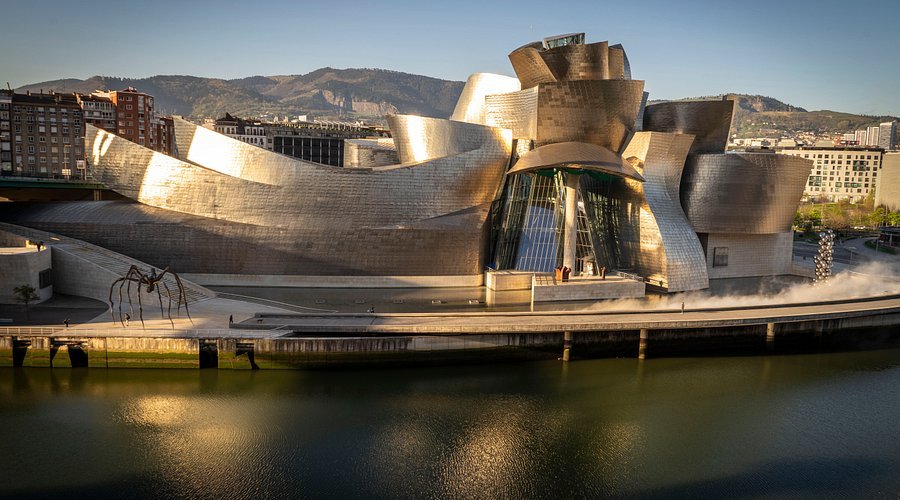
Projects such as the Guggenheim Museum Bilbao, the Jewish Museum Berlin, and Zaha Hadid’s early concrete works defined the visual language of deconstructivism. These buildings demonstrated how fragmentation and distortion could be engineered with precision rather than chaos, proving the movement’s technical credibility.
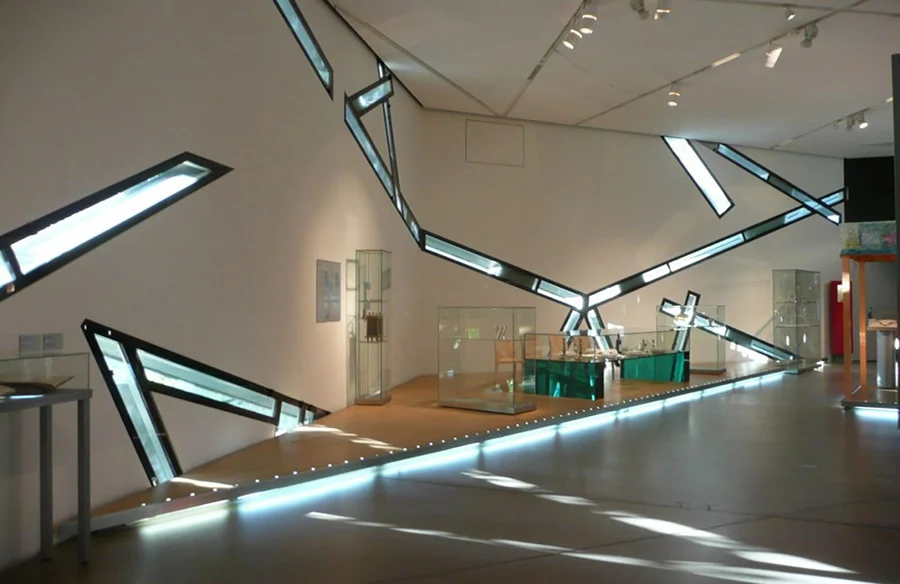
Their interiors remain influential benchmarks for experiential design, particularly in cultural, hospitality, and statement residential projects.
Deconstructivism in Contemporary Interiors
Today, deconstructivism has evolved through digital design tools and parametric modeling. Advanced software allows designers to control complexity with precision, making fragmented interiors more buildable and functional than their early counterparts.
In luxury residences, fragmented wall planes subtly define living zones while maintaining openness. In hospitality interiors, fractured ceilings and angular lighting installations create immersive environments designed for memorability and visual impact. Commercial spaces use geometric disruption to reflect innovation and forward thinking brand identities.
Design studios working in interior design in Chittagong and interior design in Bangladesh increasingly draw from these principles when clients seek interiors that move beyond minimalism and make a bold architectural statement.
Strategic Value for Modern Clients
Deconstructivist interiors are not about excess for its own sake. When applied selectively, they deliver strong spatial narratives, elevate brand perception, and differentiate projects in competitive markets. These interiors photograph well, perform strongly on digital platforms, and resonate with clients who value originality and architectural depth.
The key lies in balance. A single fragmented element, such as a sculptural staircase or angular ceiling plane, can anchor the design while surrounding spaces remain refined and functional.
Technical and Practical Considerations
Successful deconstructivist interiors rely heavily on early collaboration between designers, engineers, and fabricators. Digital modeling ensures accuracy, while lighting design plays a critical role in highlighting fractures and intersections. Materials must be carefully selected to support both visual drama and long term durability.
Final Perspective
Deconstructivism challenged architecture by rejecting stability and predictability. Its legacy is not disorder, but intention driven disruption. In contemporary interior design, these principles offer a powerful toolkit for creating spaces that engage, provoke, and leave lasting impressions. When executed with discipline, deconstructivist design transforms interiors into architectural experiences rather than mere enclosures.