
Modernism and Mid-Century: Functionalism, Bauhaus & Open-plan Living.
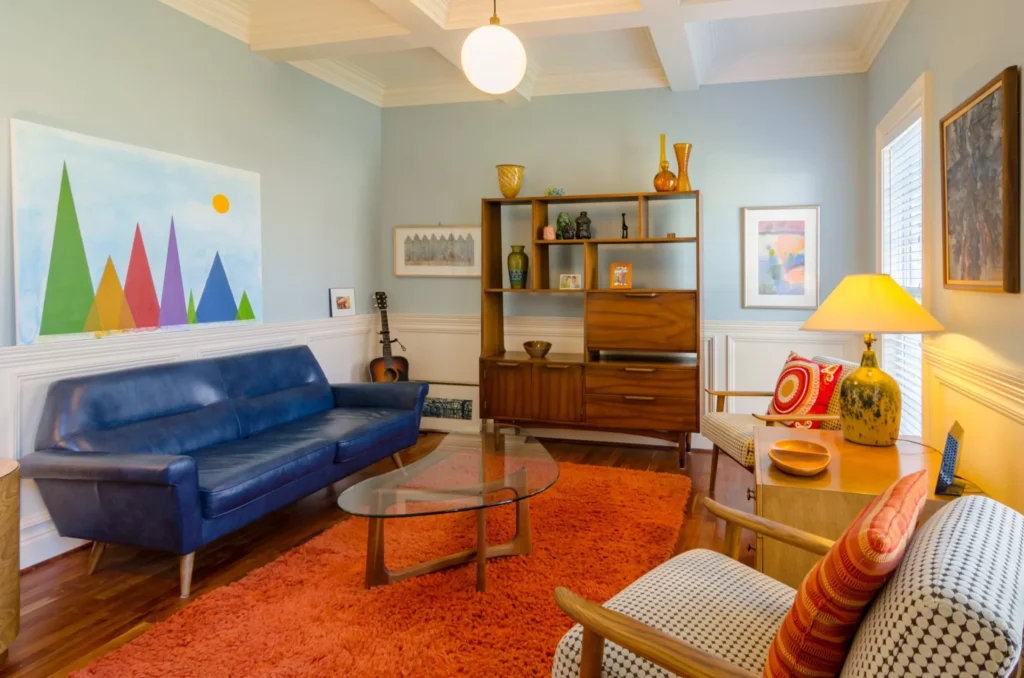
To understand the spaces we inhabit today—the clean lines of a contemporary apartment, the open flow of a living area into a kitchen, the deliberate warmth of a wooden accent against a white wall—we must look back to a revolutionary period in design history. The movements of Modernism and its more accessible successor, Mid-Century Modern, were not merely stylistic shifts. They were profound philosophical responses to a world transformed by war, technology, and a new social consciousness. They championed a radical idea: that our living environments should be shaped not by historical imitation or gratuitous ornament, but by function, honesty, and human need. This philosophy continues to resonate deeply, offering clarity and timelessness in our often-cluttered world.
The Great Unburdening: From Ornament to Essence
The dawn of the 20th century was a crucible of change. Industrialization had reshaped cities and societies, new materials like reinforced concrete and plate glass emerged, and the aftermath of the First World War demanded pragmatic, scalable solutions for housing and living. The architectural and interior design language of the preceding centuries—often characterized by heavy ornamentation, compartmentalized rooms, and a reverence for historical styles—began to feel increasingly disconnected from this new reality.
Modernism arose as a deliberate, sometimes austere, rebuttal. It was a movement built on the belief that design could and should engineer a better society. The mantra “form follows function,” popularized by architect Louis Sullivan, became its north star. This was not a rejection of beauty, but a redefinition of it. Beauty was now found in the logical expression of a building’s purpose, in the honesty of its materials, and in the efficiency of its plan. Decoration was not applied; it was inherent in the form itself. This shift represented a move from the symbolic to the experiential, from the facade to the space within.
Bauhaus: The Laboratory of Modern Life
No institution is more synonymous with the birth of this new design ethos than the Bauhaus. Founded in Germany in 1919 by Walter Gropius, the Bauhaus was less a school and more a radical workshop for the future. Its core mission was the dissolution of boundaries between art, craft, and industrial technology. “Art and technology—a new unity,” Gropius proclaimed.
Bauhaus principles were holistic, meant to design everything from a teacup to a city. They emphasized:
- Rationality & Standardization: Creating designs that could be beautifully mass-produced, making good design accessible.
- Geometric Simplicity: Reducing forms to their essential geometric components—the square, circle, and triangle.
- Truth to Materials: Letting each material speak for itself. Steel should look like steel, wood like wood, without faux finishes.
- Total Design: The concept of the Gesamtkunstwerk, or total work of art, where architecture, interior, furniture, and fixtures were conceived as a coherent whole.
The influence of Bauhaus design principles spilled out from its workshops into the world, defining the visual language of Modernism. The iconic furniture—Marcel Breuer’s Wassily Chair (exploring steel tubing), Mies van der Rohe’s Barcelona Chair (exposing structure)—were manifestos in object form. The interiors were spartan, flexible, and flooded with light, acting as calm backdrops for life itself.
Functionalism: The Architecture of Honesty
If Bauhaus was the philosophy, Functionalism was its practical application in architecture. Functionalist architects viewed buildings as machines for living in (as Le Corbusier famously stated), prioritizing efficiency, hygiene, and spatial logic. Walls were freed from their load-bearing duties by steel and concrete frames, allowing for new freedoms in interior planning. This structural honesty was meant to be expressed, not hidden.
The relationship between the building’s structure and its interior space became intimate. A exposed concrete ceiling or a brick wall became a finished interior surface. Industrial materials—steel, glass, concrete—were brought into the domestic sphere, not as cold intruders, but as noble elements in their own right. The interior was no longer a separate decorative layer applied to a shell; it was the very expression of the shell. This approach demanded a new kind of spatial thinking from architects and interior designers, one where every decision was interrogated for its purpose.
Mid-Century Modern: The Warm Embrace of Function
By the mid-20th century, particularly in the post-war optimism of the 1950s and 60s, the starkness of early Modernism began to soften. Mid-Century Modern design took the rigorous functionalist framework and infused it with organic shapes, a human scale, and a palpable sense of warmth. This was Modernism with a smile.
Driven by a booming economy and a focus on suburban family life, Mid-Century interiors became laboratories for new lifestyles. The philosophy was still resolutely functional, but it expanded to include psychological comfort and connection to nature. Designers like Charles and Ray Eames in America and Arne Jacobsen in Scandinavia led this charge. They pioneered the use of molded plywood, fiberglass, and bent steel into forms that were ergonomic, affordable, and undeniably joyful. This period mastered the balance between functionality and warmth, creating spaces that felt both efficient and deeply inviting. It demonstrated that modern residential design did not have to be cold or impersonal.
Open-Plan Living: The Liberation of Space
Perhaps the most enduring physical legacy of these movements is the concept of open-plan living. The removal of rigid, load-bearing walls was a tectonic shift in domestic life. Modernist and Mid-Century architects envisioned the main living areas—kitchen, dining, and lounge—not as a series of boxes, but as a continuous, fluid space.
This spatial freedom served multiple purposes. It promoted visual continuity and family interaction, reflecting more informal post-war social structures. It allowed natural light to penetrate deep into the heart of the home. It created a sense of expansiveness, even in modest square footages. Crucially, it forged a stronger connection between interior and exterior spaces, often through the use of floor-to-ceiling glass and strategic landscaping. The “wall” between inside and outside became blurred, drawing the garden or view into the daily experience of the home. This was not merely a stylistic choice; it was a redefinition of the home as a dynamic, flexible vessel for living, rather than a static collection of rooms.
The Material and Elemental Palette
The interior experience of these designs was defined by a specific and honest materiality.
- Wood, especially teak, rosewood, and oak, brought warmth and texture, used for cabinetry, iconic furniture, and accent walls.
- Plywood was innovatively molded into elegant, strong curves for chairs and storage.
- Metal appeared in slender, polished legs for furniture and as exposed structural elements.
- Glass was used generously in windows, doors, and tabletops to maintain visual lightness.
Furniture was characterized by clean lines, elegant proportions, and a sense of lightness—often achieved by raising cases on slender legs. Built-in storage became a cornerstone of functional interior design, aiming to eliminate clutter and maintain clean, serene surfaces. Modular shelving units and flexible seating arrangements allowed interiors to adapt to different needs, embodying the Modernist ideal of efficiency and clarity.
Light, Air, and Well-Being
Modernist and Mid-Century architects were, in essence, therapists of space and light. They understood that the interior experience was fundamentally tied to well-being. Their designs aggressively pursued natural light, using large windows, clerestories, and strategic openings to bathe interiors in sunshine. Clean, unadorned surfaces—white walls, plain ceilings, polished floors—acted as reflectors, amplifying light and creating a sense of airiness.
This focus on light and spatial flow was not aesthetic dogma; it was a direct contributor to comfort and daily pleasure. It created interiors that felt healthy, expansive, and calm. The daily ritual was enhanced by the quality of the space itself, making the home a sanctuary of clarity and order.
Living Legacy: Modernism Reinterpreted Today
The principles of Modernism and Mid-Century design are not relics; they are a living language. Contemporary interior design and architecture continually return to this wellspring for guidance. In an age of digital overload and material excess, the call for simplicity, functionality, and authenticity is stronger than ever.
Today, we see these ideas expressed in:
- Sustainable Minimalism: The honest use of natural, sustainable materials aligns perfectly with the “truth to materials” ethos, now driven by ecological awareness.
- Adaptive Open Plans: While pure open-plan is sometimes nuanced with defined zones or flexible partitions, the desire for visual connection and spatial freedom remains paramount, especially in urban apartments.
- Biophilic Integration: The Mid-Century urge to connect with nature has evolved into the formal principles of biophilic design, seamlessly bringing natural elements, materials, and light into interiors.
For any contemporary interior design firm in Chittagong working on residential or commercial projects, these principles provide an invaluable framework. They guide the creation of spaces that are not only visually compelling but are fundamentally rational, livable, and enduring. Whether designing a compact urban apartment or a sprawling villa, the lessons of spatial efficiency, material honesty, and human-centric planning are universal. A thoughtful interior design firm in Chittagong understands that applying these timeless principles means creating homes that are both modern and deeply human, capable of providing clarity and comfort for decades. This is the true testament to the movement’s power.
Conclusion: A Foundation for the Future
Modernism and Mid-Century design were more than a chapter in design history; they were a fundamental reset in how we conceive of our built environment. They shifted the question from “What should this building look like?” to “How should this space live and feel?” They replaced imitation with innovation, ornament with experience, and confinement with flow.
In their pursuit of functionalism, they discovered a profound humanism. In their stripping away of the unnecessary, they revealed the essential qualities of space, light, and material that truly nourish us. As we navigate the complexities of 21st-century life, the values they championed—clarity, efficiency, connection to nature, and an honest expression of our time—continue to offer a powerful and profoundly relevant blueprint for how to live well. The home, they taught us, is not a display case for the past, but a functional, beautiful tool for the present and a foundation for the future.