The Architecture & Interior Journal

Ideas, History, and the Future of Designed Spaces

A curated collection of articles by Design Code exploring ideas, history, and the future of designed spaces. The content connects architectural evolution with contemporary interior thinking. Each piece offers insight into how design shapes experience, function, and identity. The focus remains on informed perspectives and forward looking design.

  • Postmodern Interior Design Explained: How Playful Architecture Shapes Contemporary Spaces

    Postmodern Interior Design Explained: How Playful Architecture Shapes Contemporary Spaces

    Postmodernism emerged in the late twentieth century as architecture’s calculated rebellion against the cold logic of modernism. Where modernist interiors prioritized efficiency and restraint, postmodern spaces reintroduced emotion, symbolism, and visual storytelling. This shift transformed interiors from neutral backdrops into expressive environments designed to provoke thought, curiosity, and connection.

    Today, as clients increasingly seek interiors that feel personal rather than generic, postmodern design principles are experiencing a renewed relevance.

    Origins of Postmodern Architecture and Interiors

    Postmodernism took shape in the 1970s when architects and theorists openly challenged the idea that form must strictly follow function. Robert Venturi’s critique of minimalism reframed architecture as a communicative art rather than a purely rational system. Ornament, historical reference, and contradiction returned, not as nostalgia, but as intentional design language.

    Unlike earlier revival styles, postmodernism did not aim for historical accuracy. It borrowed, distorted, and reassembled classical motifs, allowing interiors to reference multiple eras simultaneously.

    Defining Characteristics of Postmodern Interiors

    Eclectic Composition
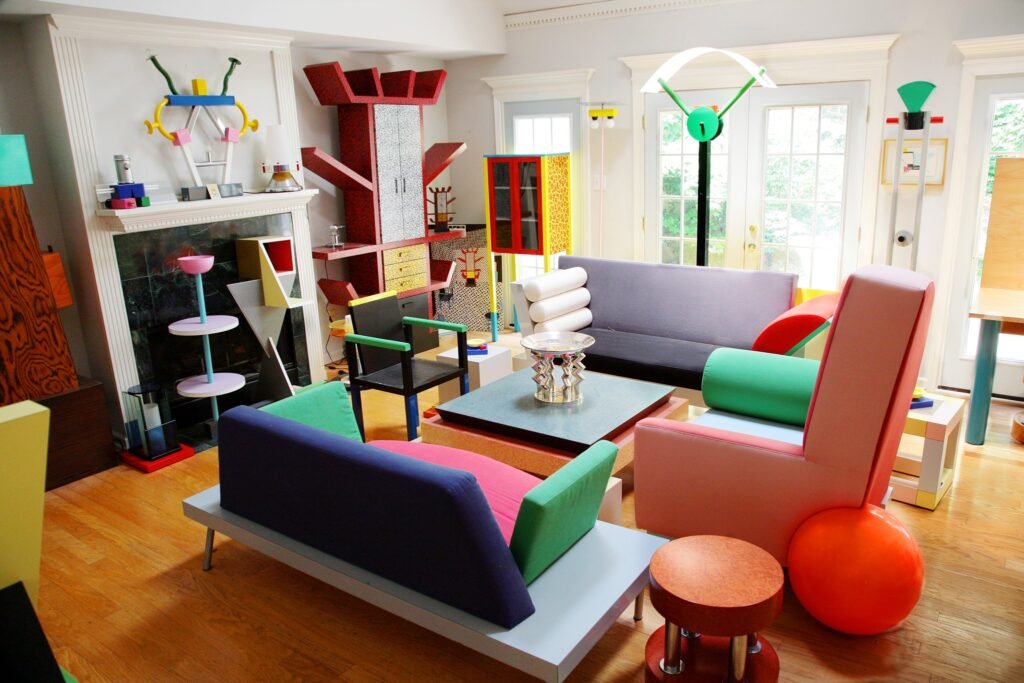
    Postmodern interiors thrive on contrast. Classical elements coexist with contemporary forms, pop culture references, and abstract geometry. A single space may combine sculptural furniture, graphic patterns, and architectural fragments, creating layered visual narratives.

    Bold and Expressive Color
    Neutral palettes give way to vibrant contrasts. Saturated hues, unexpected combinations, and color blocking energize interiors and establish focal points. This approach is often used selectively in modern projects to create memorable spaces without overwhelming function.

    Playful Proportion and Form
    Furniture and architectural elements frequently challenge conventional scale. Oversized forms, fragmented geometries, and asymmetrical layouts introduce movement and visual tension, encouraging interaction rather than passive observation.

    Material Experimentation
    Postmodern interiors favor material freedom. Glossy laminates, reflective surfaces, plush textiles, faux finishes, and patterned materials are layered to create tactile richness. This versatility allows designers to balance expressive aesthetics with practical constraints.

    Narrative Driven Detailing
    Lighting, ornament, and surface treatments often carry symbolic or ironic meaning. Interiors become storytelling tools, communicating identity and intent rather than adhering to uniform design rules.

    Iconic Influences That Shaped the Movement

    The Memphis Group, led by Ettore Sottsass, redefined furniture as expressive art. Architects such as Michael Graves and Philip Johnson reintroduced color and historical symbolism into large scale architecture, influencing how interiors could balance sophistication with playfulness. These references continue to inform contemporary design strategies, particularly in spaces that prioritize brand personality or experiential value.

    In the early 80s, Italian designer and architect Ettore Sottsass founded Memphis, a group of artists and designers who became known for their bright and bold furniture design.


    Postmodern Principles in Today’s Interiors

    Modern interpretations of postmodernism are more refined and intentional. The visual language remains expressive, but it is supported by advanced planning, technology integration, and user comfort. Bold forms are balanced with spatial clarity. Color is curated rather than chaotic.

    In urban residential projects and commercial interiors, including evolving design markets such as Chittagong, designers increasingly apply postmodern concepts to break away from repetitive layouts while still respecting lifestyle and climate considerations.

    Strategic Value for Contemporary Design

    Postmodern interiors differentiate. They invite engagement. They leave lasting impressions. In an era dominated by minimal trends and algorithm driven aesthetics, expressive interiors stand out, both physically and digitally.

    For interior design practices, postmodernism offers a framework for client storytelling, allowing spaces to reflect cultural references, personal narratives, and modern functionality without visual conformity.

    Final Perspective

    Postmodernism reshaped interior design by challenging rigidity and celebrating contradiction. Its legacy is not excess, but intention. When applied with discipline, postmodern design creates spaces that feel intelligent, layered, and emotionally resonant. As contemporary interiors continue to evolve, the movement remains a powerful reminder that design is not just about how a space works, but how it speaks.

    Contemporary and Sustainable Design: From Postmodernism to Biophilic and Tech-Integrated Spaces

    Contemporary and Sustainable Design: From Postmodernism to Biophilic and Tech-Integrated Spaces

    Contemporary architecture and interior design have undergone a remarkable evolution from the late 20th century to today. What began as a reaction to Modernism’s rigidity has transformed into a design ethos defined by sustainability, biophilic principles, and smart technology integration. This journey spans from the playful eclecticism of Postmodernism to an era where green buildings and responsive interiors are becoming the norm. In this article, we explore how philosophical shifts, material innovations, environmental responsibility, and digital tools have reshaped the way we design our homes, workplaces, and cities. The goal is to understand how these movements – from symbolic Postmodern architecture to human-centric, sustainable, and tech-enabled spaces – shape modern design practice. This comprehensive overview is written from the perspective of a seasoned architect, aiming to educate homeowners, design enthusiasts, and professionals alike. Whether you are planning your dream home or working with an interior design firm in chittagong, understanding this evolution is crucial to creating spaces that are both cutting-edge and responsible.

    Overview of Contemporary Architectural and Interior Design

    Modern design today is incredibly diverse, but certain core themes define the contemporary approach. The late 20th century saw architects rebelling against sterile glass-box modernism by embracing color, irony, and complexity. Postmodernism, with its bold forms and historical references, paved the way for a more pluralistic design language. Fast forward to the 21st century, and the spirit of reinvention continues with styles like parametricism, eco-futurism, and minimalism all coexisting. Despite their differences, contemporary architectural styles share a common context: they respond to cultural shifts, technological advances, and urgent environmental challenges.

    Two forces have become especially defining in recent decades: sustainability and technology. In the design of both buildings and interiors, environmental responsibility is now often a baseline requirement rather than an afterthought. Likewise, digital innovation has transformed both the process of design and the functionality of spaces – from how architects use Building Information Modeling (BIM) to how homeowners use smart home systems. As we shall see, sustainability and technology are not isolated trends but intersecting forces that together drive a more human-centered, adaptive, and resilient approach to design. A contemporary building is expected to save energy and connect with nature, and to offer the convenience and connectivity of the digital age, all while providing aesthetic and cultural meaning. This overview sets the stage for delving into the key movements and ideas, starting with the transition out of the Modernist era.

    From Postmodernism to Contemporary Thought

    Postmodernism emerged in the late 1960s as a critical reaction against the strict minimalism and functionalism of high modernism. Modernist architecture (epitomized by the mantra “less is more”) had produced austere, boxy forms and uniform glass-and-steel façades. In contrast, Postmodern architects championed ornamentation, symbolism, and complexity, reintroducing decorative elements and historical allusions into building design. Architects like Robert Venturi, Philip Johnson, and Michael Graves sought to make architecture more communicative and contextual. Venturi’s pivotal 1966 book Complexity and Contradiction in Architecture signaled that “less is a bore,” inviting architecture to once again embrace eclecticism and plurality. Postmodern buildings might feature playful forms, vibrant colors, or references to classical motifs – all intended to convey meaning or respond to their surroundings beyond pure function.

    In interior design, the Postmodern ethos brought a similar break from restraint. Spaces in the 1970s and 80s began to feature bold color palettes, geometric patterns, and a mix of styles. The Memphis Design movement exemplified Postmodern interiors with its brightly colored furniture, whimsical shapes, and collage of materials. This was a stark departure from the neutral tones and strict minimalism of prior decades. Postmodern interiors often told a story or made a statement – a living room might blend a modern sofa with a rococo-style mirror and pop art on the walls, all in bold hues. The aim was to create interiors with personality, historical reference, and even irony, reflecting the era’s embrace of diversity and decorative detail.

    By the turn of the 21st century, the influence of Postmodernism had opened architecture and interiors to greater stylistic freedom and context-driven design. Contemporary practice does not adhere to a single dominant style; instead, architects and designers borrow from multiple influences – a pluralism that is a legacy of Postmodernism. However, new pressing issues and philosophies arose that went beyond style for style’s sake. Globalization, climate change, and the digital revolution started to demand solutions that Postmodernism alone didn’t address. Thus, while Postmodernism broke the monotony of Modernism and enriched design with symbolism and context, the stage was set for further evolution.

    Changing Social, Environmental, and Technological Contexts

    The late 20th and early 21st centuries have seen rapid changes that profoundly affect architecture and interior design. Social and demographic shifts – such as globalization, urbanization, and new lifestyle patterns – have reshaped what we need from our spaces. At the same time, environmental imperatives like climate change have elevated sustainability from a niche concern to a central design priority. And in parallel, technological advancements have revolutionized both how we design and how we live within buildings.

    Globalization has made design ideas circulate widely, resulting in a fusion of influences in architecture and interiors. Meanwhile, cities have grown dramatically, and in Bangladesh, urban density has intensified the demand for compact, efficient living. This pressure reshapes spatial planning: open layouts to increase perceived space, built-in storage, and multifunctional rooms are now common responses.

    Climate awareness is one of the strongest forces shaping contemporary architecture. Buildings consume large amounts of energy, and architects today must address carbon footprint, operational energy use, and resilience. In warm and humid regions like Bangladesh, climate-responsive design is not optional; it is fundamental. Passive cooling, shading, cross-ventilation, roof insulation, and water management strategies help reduce dependence on mechanical systems while improving comfort.

    Technology has also altered daily spatial needs. Remote work has made the home office a standard requirement, even in small apartments. Digital connectivity influences how interiors are furnished, where outlets are placed, how lighting supports screen-based work, and how acoustics are managed. At the professional level, digital design tools allow more accurate simulations, coordinated construction documentation, and performance-based decision-making.

    Sustainable Architecture and Interior Design

    Sustainable design aims to reduce environmental harm while creating healthier interiors and more resilient buildings. It is not a single aesthetic but a design discipline grounded in performance, responsibility, and context.

    Passive design remains a cornerstone. In simple terms, it means designing with sunlight, wind, shade, thermal mass, and insulation so that a building stays comfortable with minimal mechanical heating or cooling. Orientation, window placement, shading devices, and cross-ventilation all shape energy performance. For interiors, sustainability extends to lighting efficiency, appliance selection, and planning spaces that reduce unnecessary energy use.

    Material decisions are equally central. Contemporary sustainable practice considers the full life cycle of materials: how they are sourced, produced, transported, used, and disposed of. Low-impact materials include renewable options like bamboo and responsibly harvested timber, recycled materials, and finishes with minimal toxic emissions. Durable materials that age well are often more sustainable than trend-driven finishes that require frequent replacement. Designers increasingly consider embodied carbon, choosing materials and construction approaches that reduce emissions beyond day-to-day energy use.

    Sustainable design is most effective when it responds to local conditions. In Bangladesh, traditional strategies such as courtyards, deep shading, high ceilings, and ventilated spaces are climate-smart solutions. Contemporary architects often reinterpret these ideas in modern forms, combining cultural memory with environmental performance.

    Biophilic Design: Reconnecting Humans with Nature

    Biophilic design is based on the idea that humans have an innate need for connection to nature. When buildings disconnect people from daylight, air, greenery, and natural rhythms, it affects well-being. Biophilic design reconnects occupants with nature through light, ventilation, materials, vegetation, and spatial experiences that echo natural environments.

    Practical strategies include maximizing natural light, designing for natural ventilation, adding indoor planting, creating green walls, incorporating water features, and using tactile natural materials like wood and stone. Views of nature are powerful: even a small garden view or balcony greenery can improve mood and reduce stress. In urban contexts where nature is limited, biophilic interiors provide everyday contact with living systems.

    The benefits of biophilic design include reduced stress, improved focus, better comfort perception, and enhanced psychological well-being. This is why biophilic strategies are increasingly applied in schools, hospitals, offices, and homes. A well-designed biophilic space does not rely on decoration; it integrates nature as a fundamental design component.

    In Bangladesh, biophilic thinking aligns naturally with the courtyard tradition and the social value placed on outdoor-adjacent living. Even in compact apartments, balconies, planters, rooftop gardens, and natural airflow patterns can create meaningful connections with nature. For an interior design firm in chittagong, biophilic design is increasingly relevant because dense urban living often reduces access to green space, making interior nature integration more valuable.

    Technology-Integrated Spaces and Smart Interiors

    Technology now shapes both the design process and the everyday experience of buildings. Smart interiors integrate digital systems to improve comfort, efficiency, safety, and adaptability, but the goal should always remain human-centered design rather than gadget-driven planning.

    Digital tools have transformed professional practice. BIM, parametric modeling, and simulation software enable designers to test daylight, energy use, ventilation strategies, and material quantities before construction. This reduces waste, improves coordination, and supports sustainable decision-making.

    In the built environment, smart systems include automation for lighting, climate control, shading, security, and energy monitoring. Smart lighting can adjust based on time of day, occupancy, or user preference. Automated climate systems can maintain comfort while reducing energy consumption. Sensors can improve building performance by providing real-time data and enabling responsive control.

    The key design challenge is integration. Technology must support everyday life without making interiors feel overly mechanized. Good smart design is discreet, intuitive, and adaptable. It should also consider privacy, maintenance, and long-term usability. In contemporary practice, the most successful technology-integrated spaces are those where systems disappear into the background while quietly improving spatial quality.

    Spatial Planning and Interior Expression in Contemporary Design

    Contemporary spatial planning emphasizes openness, flexibility, and refined comfort. Open plans remain popular because they increase daylight distribution and support social interaction. However, thoughtful zoning is required to maintain privacy and functionality. Designers often use furniture layouts, ceiling changes, sliding partitions, and material transitions to define spaces without closing them off.

    Flexibility is now a priority in both homes and workplaces. Multifunctional rooms and adaptable furniture respond to shifting lifestyles, including remote work and evolving family needs. The planning philosophy increasingly values spaces that can evolve over time rather than serving only one fixed function.

    Aesthetic expression has also shifted. Many contemporary interiors favor minimalism, material honesty, and clean detailing. Rather than decorative excess, designers focus on proportion, texture, and construction precision. The material palette often leans toward natural finishes, neutral tones, and restrained contrasts. This approach allows spaces to feel calm and timeless while highlighting craftsmanship.

    Comfort parameters like acoustics and lighting are now treated as design fundamentals. Open interiors and hard surfaces require acoustic planning, often through soft materials and discreet acoustic systems. Lighting is planned in layers: ambient light for overall comfort, task lighting for work surfaces, and accent lighting to create depth and atmosphere. Ergonomics and human-centered design guide the scale of furniture, circulation space, and placement of everyday elements.

    Material Innovation and Environmental Responsibility

    Contemporary design increasingly depends on material innovation. The push for environmental architecture has accelerated research into low-impact, recycled, and renewable materials, and has expanded the possibilities of fabrication and construction.

    Recycled and renewable materials are now widely used in interior and architectural finishes, including recycled wood, reclaimed brick, recycled metal, and bio-based composites. Renewable materials such as bamboo, cork, and responsibly sourced timber are valued for low embodied energy and long-term durability.

    Construction technology is evolving as well. Prefabrication and modular construction can reduce waste and improve quality by shifting production into controlled environments. Digital fabrication allows complex forms and precise joinery, often using CNC processes to minimize material loss. Emerging areas like 3D printing and experimental bio-materials suggest a future where construction becomes more circular and material waste decreases significantly.

    However, innovation is most meaningful when paired with responsibility. Materials should be selected based on durability, indoor health impact, repairability, and long-term adaptability. A truly contemporary interior is not just visually modern; it is designed to age gracefully, minimize resource depletion, and support healthy living.

    Contemporary Design in the Bangladeshi Context

    In Bangladesh, contemporary architecture and interior design are shaped by climate, density, cultural habits, and economic realities. Sustainability is often an environmental necessity rather than a design preference. The country’s hot and humid climate demands ventilation, shading, rain protection, and heat reduction strategies. Many contemporary buildings reinterpret traditional elements such as courtyards, shaded transitional spaces, and locally appropriate materials.

    Urban living in Dhaka and Chittagong requires space efficiency. Interior planning focuses on multifunctional layouts, integrated storage, and flexible spaces that can accommodate work-from-home needs. As apartments become smaller, thoughtful spatial design becomes a measure of livability rather than luxury.

    Sustainable and biophilic principles are becoming increasingly relevant across residential and commercial design. Greenery integration, improved daylight access, and natural ventilation are not only environmental strategies; they directly improve comfort and well-being in dense cities. In this context, the growing relevance of sustainable and biophilic principles for an interior design firm in chittagong is practical: it addresses urban stress, limited natural access, and the need for healthier indoor environments.

    Technology integration in Bangladesh is growing steadily, especially in higher-end residential and commercial projects. Smart lighting and security systems are increasingly common, and energy monitoring is gaining attention as electricity cost and reliability become critical concerns. The key challenge is designing smart interiors that remain practical, maintainable, and culturally appropriate.

    Influence on Future Architectural and Interior Design Practice

    Looking forward, contemporary design will likely be shaped by adaptive reuse, resilience, and deeper integration of performance-based design thinking. Adaptive reuse is increasingly important because it preserves resources and heritage while reducing construction waste. Instead of demolishing buildings, architects and interior designers are learning to transform existing structures into new uses, combining contemporary interventions with preserved character.

    Resilient design will become more central as climate risks intensify. This includes strategies for flood resistance, heat mitigation, durable material selection, and flexible building systems. Resilience also has a social component: designs must support community stability, safety, and long-term usability.

    Another major influence will be the continued merging of digital tools with design intelligence. Simulation and data analysis will increasingly guide early-stage decisions, enabling designers to predict building performance and refine interiors for comfort and efficiency. Architects and designers will function more as coordinators of systems, balancing aesthetics, environmental goals, and user experience.

    The future also points to a deeper blend of heritage and modern design. Contemporary practice will increasingly value local materials, craft, and cultural patterns, not as superficial decoration but as meaningful architectural logic. In Bangladesh, this can result in designs that feel modern while remaining rooted in climate and culture.

    Conclusion

    The evolution from Postmodernism to contemporary sustainable, biophilic, and technology-integrated design reflects more than stylistic change. It represents a shift in design philosophy. Postmodernism challenged Modernism’s rigidity and reintroduced symbolism, pluralism, and contextual thinking. That freedom enabled contemporary practice to embrace diversity, but new global realities demanded more than visual expression.

    Sustainability brought performance and responsibility to the forefront. Biophilic design expanded the goals of interiors beyond aesthetics, emphasizing human well-being through reconnection with nature. Technology-integrated spaces introduced a new layer of responsiveness and convenience, requiring designers to balance automation with human-centered design values.

    Contemporary architecture and interior design today continue to redefine how we live, work, and relate to our surroundings. The most relevant work is no longer only what looks modern, but what performs intelligently, supports health, respects culture, and responds to environmental realities. In that sense, contemporary design is not a fixed destination but an ongoing discipline—shaped by time, place, and the continuous relationship between people and the built environment.

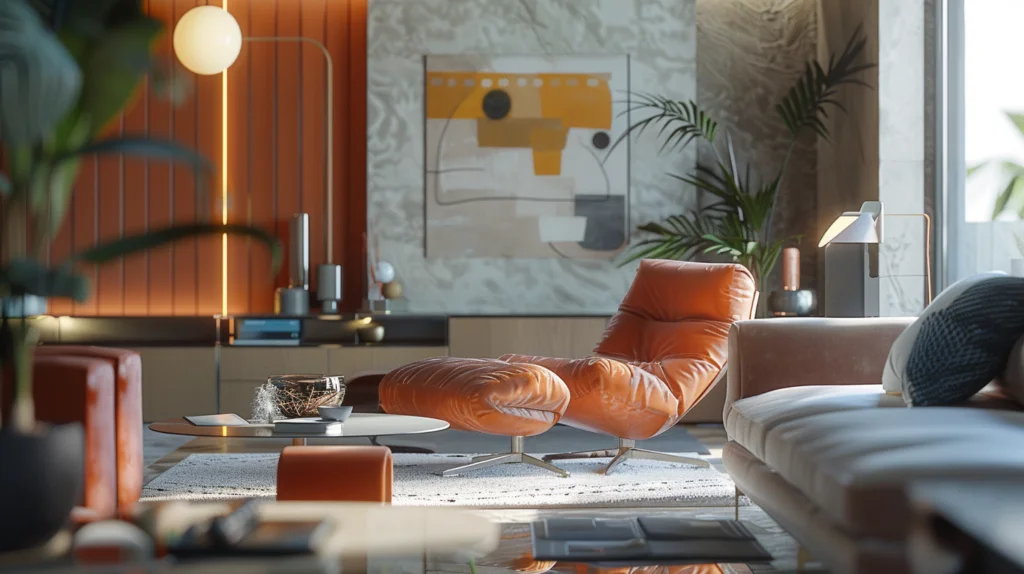
    Modernism and Mid-Century: Functionalism, Bauhaus & Open-plan Living.

    Modernism and Mid-Century: Functionalism, Bauhaus & Open-plan Living.

    To understand the spaces we inhabit today—the clean lines of a contemporary apartment, the open flow of a living area into a kitchen, the deliberate warmth of a wooden accent against a white wall—we must look back to a revolutionary period in design history. The movements of Modernism and its more accessible successor, Mid-Century Modern, were not merely stylistic shifts. They were profound philosophical responses to a world transformed by war, technology, and a new social consciousness. They championed a radical idea: that our living environments should be shaped not by historical imitation or gratuitous ornament, but by function, honesty, and human need. This philosophy continues to resonate deeply, offering clarity and timelessness in our often-cluttered world.

    The Great Unburdening: From Ornament to Essence

    The dawn of the 20th century was a crucible of change. Industrialization had reshaped cities and societies, new materials like reinforced concrete and plate glass emerged, and the aftermath of the First World War demanded pragmatic, scalable solutions for housing and living. The architectural and interior design language of the preceding centuries—often characterized by heavy ornamentation, compartmentalized rooms, and a reverence for historical styles—began to feel increasingly disconnected from this new reality.

    Modernism arose as a deliberate, sometimes austere, rebuttal. It was a movement built on the belief that design could and should engineer a better society. The mantra “form follows function,” popularized by architect Louis Sullivan, became its north star. This was not a rejection of beauty, but a redefinition of it. Beauty was now found in the logical expression of a building’s purpose, in the honesty of its materials, and in the efficiency of its plan. Decoration was not applied; it was inherent in the form itself. This shift represented a move from the symbolic to the experiential, from the facade to the space within.

    Bauhaus: The Laboratory of Modern Life

    No institution is more synonymous with the birth of this new design ethos than the Bauhaus. Founded in Germany in 1919 by Walter Gropius, the Bauhaus was less a school and more a radical workshop for the future. Its core mission was the dissolution of boundaries between art, craft, and industrial technology. “Art and technology—a new unity,” Gropius proclaimed.

    Bauhaus principles were holistic, meant to design everything from a teacup to a city. They emphasized:

    • Rationality & Standardization: Creating designs that could be beautifully mass-produced, making good design accessible.
    • Geometric Simplicity: Reducing forms to their essential geometric components—the square, circle, and triangle.
    • Truth to Materials: Letting each material speak for itself. Steel should look like steel, wood like wood, without faux finishes.
    • Total Design: The concept of the Gesamtkunstwerk, or total work of art, where architecture, interior, furniture, and fixtures were conceived as a coherent whole.

    The influence of Bauhaus design principles spilled out from its workshops into the world, defining the visual language of Modernism. The iconic furniture—Marcel Breuer’s Wassily Chair (exploring steel tubing), Mies van der Rohe’s Barcelona Chair (exposing structure)—were manifestos in object form. The interiors were spartan, flexible, and flooded with light, acting as calm backdrops for life itself.

    Functionalism: The Architecture of Honesty

    If Bauhaus was the philosophy, Functionalism was its practical application in architecture. Functionalist architects viewed buildings as machines for living in (as Le Corbusier famously stated), prioritizing efficiency, hygiene, and spatial logic. Walls were freed from their load-bearing duties by steel and concrete frames, allowing for new freedoms in interior planning. This structural honesty was meant to be expressed, not hidden.

    The relationship between the building’s structure and its interior space became intimate. A exposed concrete ceiling or a brick wall became a finished interior surface. Industrial materials—steel, glass, concrete—were brought into the domestic sphere, not as cold intruders, but as noble elements in their own right. The interior was no longer a separate decorative layer applied to a shell; it was the very expression of the shell. This approach demanded a new kind of spatial thinking from architects and interior designers, one where every decision was interrogated for its purpose.

    Mid-Century Modern: The Warm Embrace of Function

    By the mid-20th century, particularly in the post-war optimism of the 1950s and 60s, the starkness of early Modernism began to soften. Mid-Century Modern design took the rigorous functionalist framework and infused it with organic shapes, a human scale, and a palpable sense of warmth. This was Modernism with a smile.

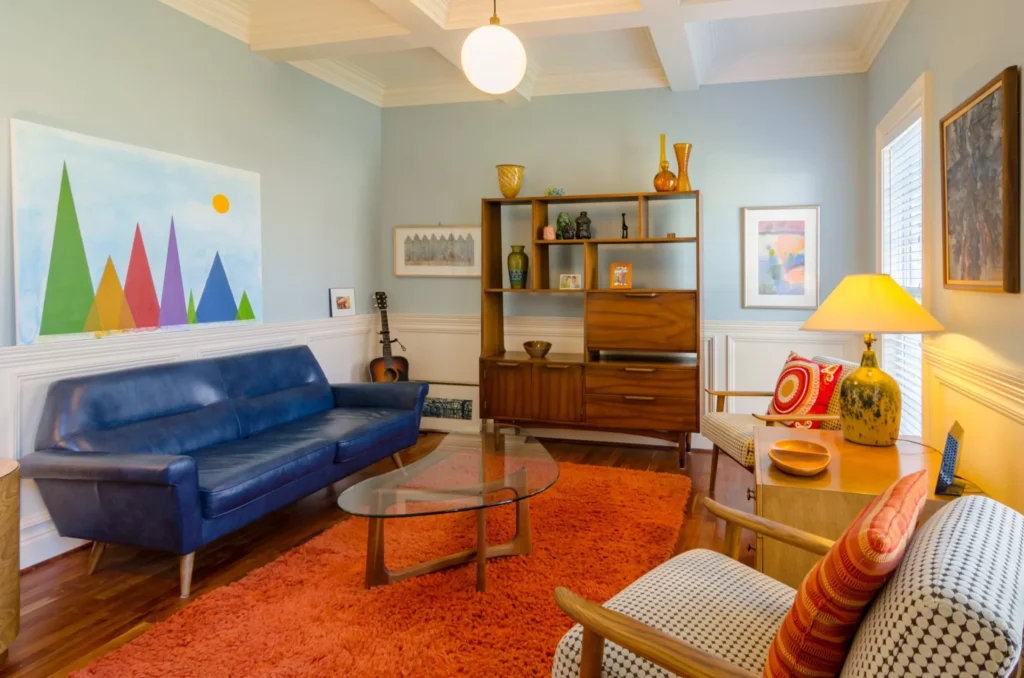
    Driven by a booming economy and a focus on suburban family life, Mid-Century interiors became laboratories for new lifestyles. The philosophy was still resolutely functional, but it expanded to include psychological comfort and connection to nature. Designers like Charles and Ray Eames in America and Arne Jacobsen in Scandinavia led this charge. They pioneered the use of molded plywood, fiberglass, and bent steel into forms that were ergonomic, affordable, and undeniably joyful. This period mastered the balance between functionality and warmth, creating spaces that felt both efficient and deeply inviting. It demonstrated that modern residential design did not have to be cold or impersonal.

    Open-Plan Living: The Liberation of Space

    Perhaps the most enduring physical legacy of these movements is the concept of open-plan living. The removal of rigid, load-bearing walls was a tectonic shift in domestic life. Modernist and Mid-Century architects envisioned the main living areas—kitchen, dining, and lounge—not as a series of boxes, but as a continuous, fluid space.

    This spatial freedom served multiple purposes. It promoted visual continuity and family interaction, reflecting more informal post-war social structures. It allowed natural light to penetrate deep into the heart of the home. It created a sense of expansiveness, even in modest square footages. Crucially, it forged a stronger connection between interior and exterior spaces, often through the use of floor-to-ceiling glass and strategic landscaping. The “wall” between inside and outside became blurred, drawing the garden or view into the daily experience of the home. This was not merely a stylistic choice; it was a redefinition of the home as a dynamic, flexible vessel for living, rather than a static collection of rooms.

    The Material and Elemental Palette

    The interior experience of these designs was defined by a specific and honest materiality.

    • Wood, especially teak, rosewood, and oak, brought warmth and texture, used for cabinetry, iconic furniture, and accent walls.
    • Plywood was innovatively molded into elegant, strong curves for chairs and storage.
    • Metal appeared in slender, polished legs for furniture and as exposed structural elements.
    • Glass was used generously in windows, doors, and tabletops to maintain visual lightness.

    Furniture was characterized by clean lines, elegant proportions, and a sense of lightness—often achieved by raising cases on slender legs. Built-in storage became a cornerstone of functional interior design, aiming to eliminate clutter and maintain clean, serene surfaces. Modular shelving units and flexible seating arrangements allowed interiors to adapt to different needs, embodying the Modernist ideal of efficiency and clarity.

    Light, Air, and Well-Being

    Modernist and Mid-Century architects were, in essence, therapists of space and light. They understood that the interior experience was fundamentally tied to well-being. Their designs aggressively pursued natural light, using large windows, clerestories, and strategic openings to bathe interiors in sunshine. Clean, unadorned surfaces—white walls, plain ceilings, polished floors—acted as reflectors, amplifying light and creating a sense of airiness.

    This focus on light and spatial flow was not aesthetic dogma; it was a direct contributor to comfort and daily pleasure. It created interiors that felt healthy, expansive, and calm. The daily ritual was enhanced by the quality of the space itself, making the home a sanctuary of clarity and order.

    Living Legacy: Modernism Reinterpreted Today

    The principles of Modernism and Mid-Century design are not relics; they are a living language. Contemporary interior design and architecture continually return to this wellspring for guidance. In an age of digital overload and material excess, the call for simplicity, functionality, and authenticity is stronger than ever.

    Today, we see these ideas expressed in:

    • Sustainable Minimalism: The honest use of natural, sustainable materials aligns perfectly with the “truth to materials” ethos, now driven by ecological awareness.
    • Adaptive Open Plans: While pure open-plan is sometimes nuanced with defined zones or flexible partitions, the desire for visual connection and spatial freedom remains paramount, especially in urban apartments.
    • Biophilic Integration: The Mid-Century urge to connect with nature has evolved into the formal principles of biophilic design, seamlessly bringing natural elements, materials, and light into interiors.

    For any contemporary interior design firm in Chittagong working on residential or commercial projects, these principles provide an invaluable framework. They guide the creation of spaces that are not only visually compelling but are fundamentally rational, livable, and enduring. Whether designing a compact urban apartment or a sprawling villa, the lessons of spatial efficiency, material honesty, and human-centric planning are universal. A thoughtful interior design firm in Chittagong understands that applying these timeless principles means creating homes that are both modern and deeply human, capable of providing clarity and comfort for decades. This is the true testament to the movement’s power.

    Conclusion: A Foundation for the Future

    Modernism and Mid-Century design were more than a chapter in design history; they were a fundamental reset in how we conceive of our built environment. They shifted the question from “What should this building look like?” to “How should this space live and feel?” They replaced imitation with innovation, ornament with experience, and confinement with flow.

    In their pursuit of functionalism, they discovered a profound humanism. In their stripping away of the unnecessary, they revealed the essential qualities of space, light, and material that truly nourish us. As we navigate the complexities of 21st-century life, the values they championed—clarity, efficiency, connection to nature, and an honest expression of our time—continue to offer a powerful and profoundly relevant blueprint for how to live well. The home, they taught us, is not a display case for the past, but a functional, beautiful tool for the present and a foundation for the future.

    Arts & Crafts and Art Nouveau: Handcrafted Rebellion Against Mass Production

    Arts & Crafts and Art Nouveau: Handcrafted Rebellion Against Mass Production

    The late 19th century marked a turning point in how we understood making things. Factories churned out identical chairs, wallpapers, and lamps at unprecedented speed, flooding homes with cheap uniformity. Yet amid this mechanical tide, a quiet rebellion stirred: designers who believed beauty should come from human hands, not assembly lines. Arts & Crafts and Art Nouveau arose not as mere styles, but as philosophies demanding material truth, artistic conviction, and a return to nature’s honest forms.

    These movements speak directly to anyone today who tires of disposable decor—architects shaping thoughtful homes in Dhaka or Chittagong, homeowners seeking originality, or clients commissioning spaces that honor craft over convenience. In an era of digital fabrication, their insistence on handcrafted design remains a potent reminder that interiors can carry the warmth of individual creation.

    Background of late 19th-century industrialization

    The Industrial Revolution’s second wave transformed Europe and America. Steam-powered machines enabled mass production, lowering costs but eroding quality. William Morris, a pivotal figure, decried “the injuriousness of machinery” in his 1851 lecture, arguing it deskilled workers and dulled sensibilities. Homes filled with shoddy imitations of historical styles—machine-stamped Gothic arches, aniline-dyed fabrics—left a cultural void.

    This dissatisfaction fueled a broader critique. John Ruskin and Morris saw design as moral act: good work ennobles both maker and user. Across Britain, the continent, and eventually the world, this ethos birthed movements that prioritized the workshop over the factory.

    Growing dissatisfaction with mass-produced design

    By the 1880s, architects and artists railed against Victorian eclecticism’s chaos. Mass production prioritized quantity, yielding brittle furniture prone to splintering and wallpapers that peeled after a season. Critics like Morris founded the Society for the Protection of Ancient Buildings in 1877, championing repair over replication and handcraft over haste.

    This unrest set the stage for anti-industrial design, where every nail, weave, and curve bore the mark of deliberate choice—a stark contrast to the anonymous churn of factories.

    The Arts & Crafts Movement: A Return to Craftsmanship

    Arts & Crafts crystallized in Britain during the 1860s, led by Morris and his circle at the Red House, designed by Philip Webb. It was less a style than a creed: reject the machine, revive medieval guild traditions, integrate art into daily life.

    Historical origins and philosophy

    Rooted in Pre-Raphaelite ideals and socialist thought, the movement spread through Morris’s Kelmscott Press and the Century Guild. Exhibitions like the Arts & Crafts Exhibition Society’s 1888 show showcased unified ensembles—houses, furnishings, textiles—created by collaborative workshops.

    Philosophy centered on joy in labor. As Morris wrote, “Have nothing in your houses that you do not know to be useful or believe to be beautiful.” This demanded designers live their ideals, often establishing communal workshops.

    Emphasis on honesty of materials and handcraft

    No veneers hid lesser woods; oak or chestnut stood bare, grain celebrated. Hammer marks on ironwork, visible tool strokes on pottery—these imperfections affirmed human touch. Interiors eschewed fussy trim for sturdy, functional forms that aged gracefully.

    Relationship between architecture, interior design, and furniture

    Unity was paramount. Charles Rennie Mackintosh in Glasgow designed entire rooms, from masonry to Morris chairs. Built-ins—settles, cabinets—dissolved boundaries between structure and furnishing, creating cohesive spaces where every element served the whole.

    Interior Design Principles of Arts & Crafts

    Arts & Crafts interiors feel grounded, like extensions of the earth itself. They prioritize calm endurance over fleeting trends.

    Natural materials and earthy color palettes

    Oak paneling, rush-seated chairs, wool rugs in muted greens, ochres, and indigos dominated. Stone hearths, brick arches, and limewash walls breathed texture. Colors drew from landscape—mossy tones, autumnal russets—creating sanctuary-like atmospheres.

    Built-in furniture and functional beauty

    Recessed bookcases, inglenooks, window seats maximized utility without clutter. Furniture eschewed ornament for honest joinery: pegged mortise-and-tenon, exposed dovetails. Beauty emerged from proportion and use, not added gimcrack.

    Simplicity, proportion, and human scale

    Rooms favored low ceilings, generous hearths, and intimate groupings. Proportion echoed vernacular cottages—1:√2 ratios in panel heights, balanced asymmetry in elevations. This human scale fostered comfort, countering industrial alienation.

    For a contemporary interior design firm in Chittagong working on heritage-inspired homes, these principles offer timeless restraint: spaces that invite lingering without overwhelming.

    Art Nouveau: Nature as Inspiration

    Art Nouveau burst forth around 1890, radiating from Brussels, Paris, and Vienna. Where Arts & Crafts hunkered in moral rectitude, Art Nouveau danced with exuberance, dubbing itself “new art” to signal total renewal.

    Cultural and artistic background

    Fueled by World’s Fairs—especially Paris 1900—it rejected 19th-century historicism. Architects like Victor Horta and Hector Guimard drew from Japanese prints, Symbolist paintings, and emerging organic sciences. Sinuous lines symbolized modernity’s vital flow.

    Rejection of historical imitation

    No neo-Gothic or Renaissance pastiche; instead, whiplash curves mimicked irises, lilies, female hair. This decorative arts revolution infiltrated metros, department stores, and homes, proving ornament could innovate rather than imitate.

    Celebration of creativity and decorative freedom

    Art Nouveau empowered the individual artist. Glassmakers like Émile Gallé, jewelers like René Lalique, fused fine and applied arts. Interiors became total artworks—Gesamtkunstwerk—where walls flowed into furniture like living vines.

    Organic Forms, Lines, and Ornamentation

    Art Nouveau’s signature was the ligne nouvelle: supple, asymmetric lines evoking growth.

    Flowing curves and plant-inspired motifs

    Stair balustrades swirled like tendrils; door panels bloomed with poppies. Ceilings undulated softly, walls bowed inward like petals. Motifs—dragonflies, peacock feathers, seaweed—infused spaces with organic vitality.

    Integration of structure and decoration

    Exposed iron bones became sculptural, as in Horta’s Hôtel Tassel, where tendril-like columns supported glazed vaults. Decoration was structural poetry: no flat panels, every surface alive with movement.

    Artistic unity between interior elements

    Floor lamps echoed window tracery; rugs swirled in sympathy with iron grilles. This holistic approach ensured interiors pulsed as single organisms, each detail reinforcing the whole.

    Materials, Craft, and Decorative Arts

    Both movements exalted matter’s innate poetry, handled by skilled hands.

    Wood, iron, glass, ceramics, and textiles

    Arts & Crafts favored quarter-sawn oak, hammered copper, oatmeal linens. Art Nouveau embraced exoticism: pearwood inlays, opalescent glass, faience tiles. Materials revealed process—frosted glass etched by hand, iron forged with visible welds.

    Stained glass, metalwork, and hand-crafted details

    Tiffany’s favrile glass cast jewel-like glows; Lalique’s frosted figures caught light prismatically. Metalwork ranged from Mackintosh’s stark geometrics to Mucha’s floral bronzes. Textiles bore block-printed patterns, yarns hand-spun for texture.

    Role of artisans in interior creation

    Workshops like Morris & Co. or the Wiener Werkstätte employed specialists—block-printers, gilders, turners—ensuring mastery. This guild revival democratized luxury: even middle-class homes could host bespoke beauty.

    Arts & Crafts vs Art Nouveau: Shared Ideals and Differences

    Sisters in rebellion, these movements diverged in expression.

    Common resistance to industrial uniformity

    Both scorned shoddy goods, championing small-batch production and designer-maker unity. They elevated everyday objects—teapots, tiles—elevating domestic life against factory drudgery.

    Differences in visual expression and ornamentation

    Arts & Crafts sought medieval simplicity: straight lines, minimal motifs, moral plainness. Art Nouveau reveled in excess: florid curves, asymmetry, sensual abundance. One was austere hearth, the other garden in bloom.

    Cultural influence across regions

    Arts & Crafts begat American Craftsman bungalows, Japanese mingei. Art Nouveau morphed into Catalan Modernisme (Gaudí) and Austrian Secession. In colonial contexts like British India, hybrid forms emerged— bungalow verandas with wrought-iron lilies—blending local craft with imported ideals.

    Impact on Modern Interior Design

    These movements seeded modernism while nurturing craft revivals.

    Influence on contemporary handcrafted and bespoke interiors

    Mid-century modernists like Frank Lloyd Wright credited Arts & Crafts for built-ins and materiality. Today, bespoke makers echo them: live-edge tables, hand-planed panels in urban lofts.

    Revival of material authenticity

    In an age of laminates and 3D prints, their honesty resonates. Exposed brick, raw linen, patinated brass reclaim tactility, countering digital sterility.

    Application in residential, hospitality, and creative spaces

    Hospitality draws on Art Nouveau’s drama—curved lobby desks, etched screens—for immersive stays. Residences blend Arts & Crafts inglenooks with Nouveau lamps for layered warmth. An interior design firm in Chittagong might weave these into tropical homes: teak joinery, jute weaves, sinuous ceiling fans honoring local hands alongside historical precedents.

    Contemporary historical interior styles thrive by distilling their essence: organic forms softening stark modernism, handcrafted accents grounding minimalism.

    Conclusion

    Arts & Crafts and Art Nouveau remind us that design’s soul lies in human intent—the stroke of chisel, twist of wire, warp of loom. Born from industrial shadows, they reclaimed beauty as birthright of craft, proving machines cannot replicate the imperfect poetry of hands.

    In our automated present, their relevance deepens. As algorithms generate form, these movements urge return to origin: materials speaking truth, spaces fostering creativity, interiors bearing the quiet authority of artistic integrity. They teach that true originality endures, handwoven into the fabric of thoughtful living.

    Neoclassicism and Industrial Revolution: Revived Classics Meets Iron-framed Factories

    Neoclassicism and Industrial Revolution: Revived Classics Meets Iron-framed Factories

    In the late 18th and 19th centuries, architecture and interior design underwent a dramatic transformation. The elegance of Neoclassicism – a revival of Greek and Roman ideals – suddenly found itself sharing the stage with the brute force of the Industrial Revolution’s iron and steam. This was a pivotal turning point in design history, where timeless classical principles collided with cutting-edge industrial technology. The result was an era of “Revived Classics” meeting Iron-framed Factories, setting the foundation for many ideas that architects and interior designers still draw upon today.

    In this article, we explore how Enlightenment-era classical revivalism coexisted and intertwined with the new industrial materials and construction techniques, and how that extraordinary fusion continues to influence contemporary design practices.

    Overview of Neoclassicism and the Industrial Revolution

    Neoclassicism emerged in mid-18th century Europe as a return to the forms and values of classical antiquity. Architects inspired by ancient Greece and Rome emphasized simplicity, symmetry, and proportion as guiding principles. Buildings from this movement feature Greek temple elements – columns, pediments, domes – composed with clean lines and restrained ornament to suit Enlightenment ideals of reason and order. In essence, Neoclassical architecture was a “new classic” seeking to strip away Baroque excess and revive the harmonious geometry of antiquity. Interior design in this style likewise favored balance and clarity over opulence, using muted colors and classical motifs in moderation to create an atmosphere of refined elegance.

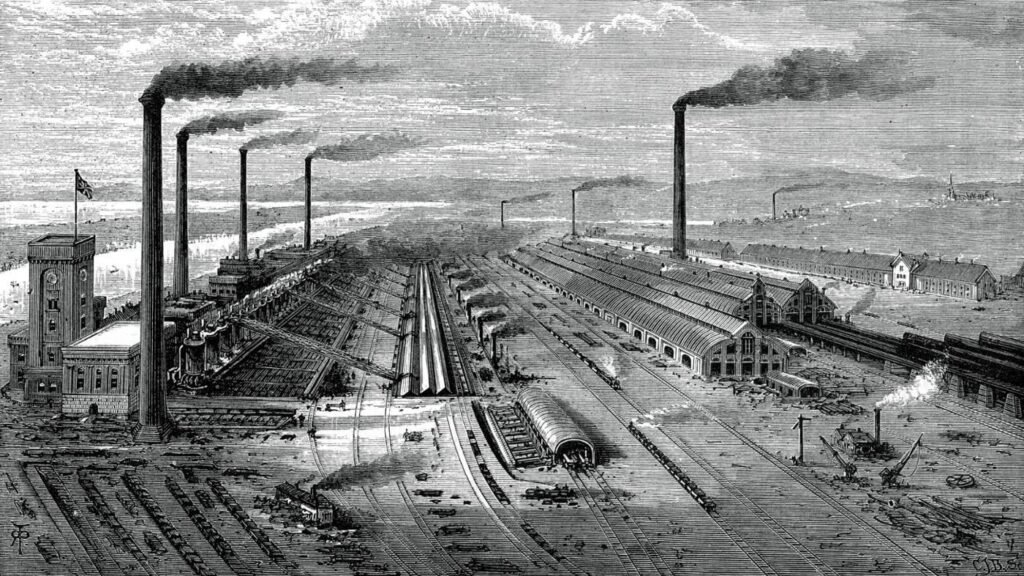
    Industrial Revolution architecture, by contrast, was driven by 19th-century technological leaps that introduced iron, steel, and glass as building materials. Engineers and architects began harnessing these materials to erect structures taller, wider, and more utilitarian than ever before. The new factories, mills, and railway stations prioritized function and structural honesty – an approach that turned architecture from handcraft into engineered precision. Traditional masonry gave way to iron frames and vast sheets of glass, enabling buildings with previously unimaginable scale and light-filled interiors.

    Neoclassicism looked backward to classical ideals of beauty and order, while the Industrial Revolution thrust design forward with groundbreaking materials and methods. Understanding the duality of this period is crucial for architects and designers today, including professionals serving clients in Bangladesh.

    Historical Context: Europe on the Edge of Transformation

    The convergence of Neoclassicism and industrialization did not happen in a vacuum – it was the product of profound historical currents. Enlightenment ideals fostered a renewed admiration for classical antiquity. Scholars and artists believed that Greek and Roman art held timeless virtues of reason, civic virtue, and moral clarity. Archaeological discoveries of ancient sites fueled popular fascination with antiquity, reinforcing the urge to emulate classical models.

    Neoclassicism’s rise mirrored broader political and philosophical shifts. There was a sense that to build in the image of Athens or Rome was to channel their enlightened governance and cultural greatness. At the same time, society was turning away from the frivolity of Rococo art toward something more rational and serious. Architecture became a vehicle for expressing clarity and civic virtue through order, symmetry, and measured restraint.

    While Neoclassicism looked to the past, industrialization propelled Europe into the future. Mechanized manufacturing, steam power, and mass production created new cities, new economies, and new building demands. A growing industrial middle class expanded cities rapidly, while rail networks and factories reshaped the landscape.

    The needs of industrial society spurred rapid advancements in building technology. Iron bridges, machine houses, mills, and stations required new structural thinking. Engineers began experimenting with prefabricated parts, modular systems, and larger spans. Buildings could now be partly made off-site and assembled efficiently on-site, introducing a construction logic that foreshadowed modern industrialized building practices.

    Europe around 1800 was intellectually looking back to Antiquity for inspiration, yet materially rushing forward under the force of industrial change. This unique context set the stage for a design revolution where classical beauty and industrial ingenuity could meet.

    Neoclassical Architecture and Interior Design

    Neoclassical architecture drew directly from the vocabulary of Greek and Roman antiquity, reinterpreting it for modern use. Architects sought buildings that embodied the symmetry, rational proportions, and dignified simplicity of ancient temples and civic structures. The movement rose as a deliberate reaction against the dramatic curves and lavish decoration of Baroque and Rococo design. Instead of gilded excess, Neoclassicism emphasized clean lines and restrained ornamentation.

    Underlying Neoclassical design was a belief that beauty lies in balanced proportions and order. Facades and floor plans were typically organized along strong central axes with symmetrical arrangements of spaces on either side. This axial planning created a clear spatial hierarchy – an entrance aligned to a grand hall, a rotunda, or a garden vista.

    In Bangladesh, several heritage-era institutional and civic buildings show traces of neoclassical influence through symmetry, colonnaded fronts, and formal massing. Even where details differ due to climate, materials, and colonial-era construction methods, the underlying ideas of balanced composition and monumental civic identity remain visible.

    Interior characteristics: spatial discipline and classical restraint

    Neoclassical interiors adopted a “less is more” ethos compared to the preceding Rococo era. Designers used flatter, lighter decorative motifs drawn from ancient art, often arranged in frieze-like bands or panels. Walls might be painted in antique-inspired hues and accented with delicate classical figures, wreaths, urns, and low-relief plaster ornament.

    Key interior features included:

    • Columns and pilasters framing openings and walls
    • Classical ornamentation used sparingly rather than heavily layered
    • Symmetry in door and window placement, often centered on a fireplace or niche
    • Ceilings and floors aligned with the room’s geometry to reinforce proportion

    Color schemes tended toward soft whites, creams, and gentle blues or greens, sometimes offset with restrained gilding. Lighting was arranged to enhance balance and calm rather than theatrical drama. The resulting atmosphere was one of cultivated order, where decoration supported structure rather than competing with it.

    Furniture followed the same logic: clean profiles, classical motifs, and a preference for measured elegance. The Neoclassical interior was ultimately about spatial proportion, architectural symmetry, and disciplined ornament.

    The Industrial Revolution and Architectural Innovation

    The Industrial Revolution introduced a radically different design driver: technology. Starting in the late 18th century and accelerating through the 19th, advancements in engineering and manufacturing changed what buildings could be.

    Iron and later steel altered construction fundamentally. Metal frames could support heavy loads while allowing large spans and thinner structural profiles than masonry. These innovations enabled buildings with larger footprints, taller floors, and more expansive interiors. New building types emerged rapidly: factories, warehouses, mills, docks, exhibition halls, and railway stations.

    Industrial architecture introduced a new logic of planning:

    • layouts shaped by workflow and production
    • circulation designed for materials and machinery
    • structural systems expressed openly rather than hidden
    • repeated modules for speed and efficiency

    This era also expanded interior scale. Metal framing allowed interiors that felt cavernous compared to pre-industrial rooms. Large halls became possible with fewer walls, and daylight could penetrate deeper through bigger windows and glazed roofs.

    Industrial design did not eliminate style overnight, but it placed function and performance at the center of architectural thinking. This shift would later influence early modern interiors and the broader philosophy of modern architecture.

    Iron-Framed Factories and Industrial Interiors

    The iron-framed factory became one of the clearest symbols of the period. These buildings introduced a new aesthetic: structure as expression. The grid of columns, beams, and repetitive bays produced a clear rhythm — not unlike classical colonnades — but driven by construction efficiency rather than historical reference.

    Industrial interiors were typically:

    • large open spans with minimal partitions
    • flexible floors that could adapt to changing machinery
    • repetitive structural grids creating modular planning
    • abundant natural light through tall windows and skylights

    Material aesthetics were direct and often raw: brick walls, iron or steel frames, timber floors, and utilitarian finishes. Many of the qualities now associated with industrial interiors — exposed structure, visible services, honest materials — emerged from practical necessity.

    Natural light was essential. Factory designers used rows of large windows, roof monitors, and skylights to reduce reliance on artificial lighting and improve working conditions. The scale of these interiors, combined with their openness, shaped a spatial sensibility that continues to influence contemporary architecture and commercial interiors.

    Collision and Coexistence: Classical Ideals vs Industrial Efficiency

    Although Neoclassicism and industrial architecture seem opposed, the 19th century produced many buildings where they intersected.

    How neoclassical aesthetics adapted to new materials

    Many civic and institutional buildings retained classical facades and planning discipline while adopting iron framing or metal roof structures behind the scenes. Classical form provided cultural legitimacy and monumentality, while industrial materials provided span, fire resistance, speed, and new structural possibilities.

    Large domes, long halls, and expansive roof systems were sometimes made possible or improved through metal construction. In some cases, iron elements were intentionally concealed to preserve the visual language of stone-based classicism. In others, metal became part of the architectural character.

    Industrial buildings borrowing proportion and rhythm

    Industrial buildings, on the other hand, sometimes borrowed classical principles unintentionally through the logic of repetition and proportion. The regular spacing of columns and windows created rhythmic facades and a sense of order. Even without columns and pediments, the industrial grid can feel “classical” in its discipline.

    This era therefore produced an important design lesson: classical architecture is not only about ornament, but also about structure, proportion, and repetition — principles that can exist even in utilitarian buildings.

    Interior Atmosphere and Material Expression

    The interior atmosphere of Neoclassical spaces and industrial spaces differed sharply, and that contrast remains instructive.

    Neoclassical interiors were designed for social life and representation. Their proportions were carefully tuned to human scale, and their surfaces were refined. Ornament was controlled, and light was shaped to produce calm, balanced environments.

    Industrial interiors were shaped by labor, machinery, and mass production. They were often loud, echoing, and expansive. Surfaces were hard and unfinished. Lighting was generous but direct. The scale could feel monumental, but not in the ceremonial way of classical halls — rather in a functional, machine-driven sense.

    Acoustics, light control, and spatial scale

    • Classical rooms moderated sound through layered finishes, textiles, and controlled proportions.
    • Factories and stations amplified sound due to large volumes and hard surfaces.
    • Classical interiors used filtered daylight and warm artificial light to soften atmosphere.
    • Industrial buildings maximized daylight for productivity, creating brighter, more direct illumination.

    Furniture, fixtures, and built-in elements

    Neoclassical interiors integrated furniture as part of an ordered composition — centered, balanced, and stylistically unified. Industrial spaces prioritized functional fixtures: benches, machinery supports, cranes, storage racks, and later metal office furnishings. In industrial environments, the “built-in elements” were often mechanical and structural rather than decorative.

    The contrast between these two interior worlds still informs modern design choices: refined vs raw, concealed vs exposed, ceremonial vs functional.

    Influence on Contemporary Architecture and Interior Design

    The legacy of this era continues to shape architectural thinking and interior design practice worldwide — including in Bangladesh, where heritage context and modern development often meet in complex ways.

    Modern reinterpretations of neoclassical symmetry

    Neoclassical principles remain relevant because they address fundamentals: spatial proportion, hierarchy, and visual order. Contemporary designers still use symmetry, axial planning, balanced massing, and restrained classical detailing to create timeless interiors — especially in residential projects, formal reception areas, and civic environments.

    In Bangladesh, designers frequently encounter clients who appreciate classical calmness and proportion, particularly when designing homes and hospitality spaces that aim for long-term elegance rather than trend-based styling. An interior design firm in chittagong may interpret these principles today through simplified moldings, balanced layouts, and carefully aligned openings, even when using modern materials.

    Industrial style interiors in residential and commercial spaces

    Industrial interiors are now common in cafés, offices, studios, and contemporary homes. Exposed brick, visible steel elements, concrete floors, and high ceilings are used to create a sense of honesty, history, and spatial openness. The popularity of “loft” living and open-plan commercial interiors is closely linked to the spatial logic first tested in industrial buildings.

    Designers often borrow industrial cues even in new construction: steel-framed partitions, factory-style window grids, exposed lighting tracks, and mixed material palettes that combine metal, wood, and brick.

    Adaptive reuse of factories and heritage buildings

    Globally, the adaptive reuse of industrial buildings has become a mature architectural strategy. Old mills, warehouses, and power stations are converted into museums, offices, housing, and cultural venues. This approach preserves historic fabric while enabling contemporary programs.

    In Bangladesh, adaptive reuse is increasingly relevant where heritage buildings survive in dense urban contexts. The discipline required is similar everywhere: protect the structural character, retain the spatial drama, and introduce new systems with minimal disruption. In many cases, the most successful results come from respecting both classical and industrial legacies — keeping the strength of the old structure while designing interiors that meet modern comfort and use.

    Subtle integration of historical elements in modern projects

    Many contemporary projects integrate historical references subtly rather than literally: a symmetrical plan without overt columns, industrial textures paired with refined proportions, or a modern interior inserted into a heritage envelope.

    This blended approach is increasingly common in Bangladesh’s urban design projects, where modern lifestyles must fit within culturally layered environments. Again, an interior design firm in chittagong may draw from this period when working with older buildings, using classical spatial discipline alongside industrial-material honesty.

    Conclusion

    Neoclassicism and the Industrial Revolution together shaped the architecture and interiors of the modern world. Neoclassicism revived timeless principles of order, proportion, and restraint. The Industrial Revolution introduced iron and steel construction, new building types, and a functional planning logic that expanded scale and transformed interior space.

    This era remains relevant because it showed that architectural progress is not only about new materials, and tradition is not only about decoration. The most lasting lesson is the value of structure, material innovation, and spatial discipline — whether expressed through a classical portico or an iron-framed factory hall.

    For architects, interior designers, and design-minded clients today, the period offers a rich framework: classical ideas can guide proportion and hierarchy, while industrial innovations can guide structure, flexibility, and honesty of materials. The dialogue between these two forces continues to shape contemporary design language, ensuring that the meeting of revived classics and industrial construction remains an ongoing and deeply productive influence.

    Baroque and Rococo Ornamentation: Dramatic Curves, Gilding & Theatrical Spaces

    Baroque and Rococo Ornamentation: Dramatic Curves, Gilding & Theatrical Spaces

    Baroque and Rococo ornamentation stands as one of the most visceral chapters in the history of interior design. These styles transformed spaces into theaters of emotion, where every curve, gleam of gold, and play of shadow conspired to move the viewer. What began as a bold assertion of power in vast palace halls evolved into delicate, intimate expressions of pleasure and wit.

    For those drawn to expressive interiors; whether outfitting a Dhaka residence, a Chattogram hotel lobby, or a private salon; these historical movements offer lessons in creating environments that stir the senses. Baroque architecture demands attention with its monumental sweep; Rococo interiors whisper seduction through asymmetry and lightness. Together, they remind us that design can be as much about feeling as it is about function.

    Overview of Baroque and Rococo periods

    Baroque emerged in late 16th-century Italy as a counterpoint to the measured calm of Renaissance forms. By the early 17th century, it had spread across Europe, fueled by the Catholic Church’s desire for art that overwhelmed the senses and reaffirmed faith amid Reformation doubts. Interiors became stages for drama: soaring vaults, twisted columns, and undulating surfaces that seemed to pulse with energy.

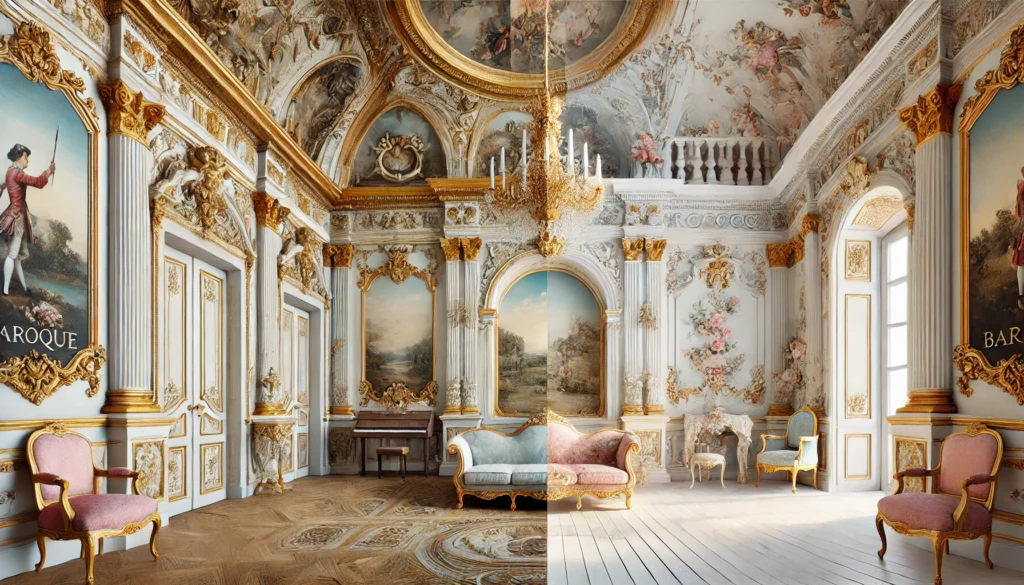
    Rococo followed in the early 18th century, primarily in France, as a reaction to Baroque’s heaviness. It softened the edges, introducing shell-like motifs, playful asymmetry, and pastel palettes suited to aristocratic salons. Where Baroque projected grandeur, Rococo cultivated charm—yet both shared a profound commitment to ornamentation as the soul of space.

    Their role in shaping expressive interior design cannot be overstated. These styles elevated decoration from mere embellishment to structural poetry, influencing everything from gilded interiors to theatrical spaces that still captivate today.

    The Emergence of Baroque Design

    Baroque design crystallized amid profound cultural shifts. The Thirty Years’ War ravaged Europe, while absolute monarchs like Louis XIV sought to project unassailable power. Architecture became a tool of propaganda, with interiors designed to awe visitors and embody divine order on earth.

    Historical and cultural context

    In Rome, architects like Gian Lorenzo Bernini blurred the line between sculpture and space, filling churches with swirling marble and dramatic light. Versailles under Louis XIV epitomized this on a national scale: endless mirrored galleries and sculpted gardens reinforcing the Sun King’s radiance. Across Catholic Europe—Spain, Austria, southern Germany—similar impulses drove the creation of palace interiors and ecclesiastical spaces brimming with movement.

    Protestant north Europe adopted a more restrained Baroque, but the core impulse remained: to evoke emotion through scale and ornament.

    Desire for emotional impact and grandeur

    Unlike the intellectual poise of classical proportion, Baroque sought visceral response. Interiors were choreographed to guide the eye upward, around corners, and into infinity. This emotional charge made spaces feel alive, almost breathing—a quality that resonates in contemporary ornamental design seeking to transcend the mundane.

    Dramatic Curves and Spatial Movement

    Baroque broke free from straight lines, introducing curves that imparted a sense of perpetual motion. Walls bowed outward, staircases spiraled like helices, and ceilings cascaded in waves of plaster.

    Curved walls, staircases, and ceilings

    Consider the Scala Regia in the Vatican: Bernini’s staircase compresses and expands space through convex and concave walls, drawing visitors inexorably forward. Ceilings, too, rejected flatness—undulating ribs and pendentives created a sense of upward thrust, as if the room aspired to heaven.

    In palace interiors, these curves unified disparate elements, turning rigid boxes into fluid experiences.

    Sense of motion and fluid spatial planning

    Movement became architectural vocabulary. Doorways framed vistas that twisted into adjoining rooms, creating enfilades alive with directional energy. This fluidity influenced spatial planning profoundly: no corner felt static; every transition promised revelation.

    Visual rhythm within interiors

    Rhythm emerged from repeating motifs—acanthus scrolls, cartouches, and volutes—that linked floor to ceiling. This orchestrated flow prevented ornament from overwhelming, instead propelling the gaze like a musical phrase.

    Light, Shadow, and Theatrical Atmosphere

    Light in Baroque and Rococo interiors was no accident; it was the director’s cue. Strategic placement amplified drama, turning surfaces into luminous events.

    Strategic use of natural and artificial light

    Hidden windows and clerestory openings raked light across textured walls, casting shadows that accentuated relief. At night, candelabra and early chandeliers multiplied flames, their reflections dancing in polished surfaces.

    Contrast and depth in interiors

    High contrast defined the mood: deep shadows against gilded highlights, matte stones yielding to shimmering silks. This chiaroscuro effect lent depth, making even modest rooms feel cavernous and profound.

    Psychological impact of lighting

    The result was theatrical spaces that manipulated perception—spaces that felt larger, more sacred, or more intimate by design. For a modern interior design firm in Chittagong crafting hospitality venues, this mastery of light remains a blueprint for evoking wonder without gimmicks.

    Gilding and Surface Ornamentation

    Gold was Baroque’s signature, applied with abandon to assert wealth and divinity. Rococo refined it into delicate tracery.

    Use of gold leaf and decorative finishes

    Gold leaf burnished on plaster, wood, and canvas caught light like liquid fire. Patinas of verdigris or bronze provided counterpoint, while bole (clay undercoat) allowed subtle color shifts.

    Wall panels, moldings, and ceiling details

    Walls dissolved into boiserie—carved panels alive with foliage, shells, and mythical beasts. Ceilings erupted in quadri riportati, painted illusions of architecture framing frescoes. Moldings swelled and receded, blurring structure and decoration.

    Relationship between structure and decoration

    Ornament was not applied; it was grown from the architecture. Columns twisted into solomonic forms, capitals sprouted flora—this organic fusion made surfaces feel tectonic, not tacked-on.

    Baroque Interiors: Grandeur and Power

    Baroque interiors served power’s theater, from Vatican corridors to Habsburg ballrooms.

    Palace halls, churches, and ceremonial spaces

    The Hall of Mirrors at Versailles orchestrated 357 mirrors to double infinity, amplifying Louis XIV’s glory. Churches like St. Peter’s fused nave and dome in a crescendo of marble and gilt.

    Monumental scale and formal layouts

    Scale awed: double-height galleries, colossal orders, ceilings that demanded neck-craning awe. Layouts followed axes of approach, building to climactic saloons.

    Emotional storytelling through space

    Each room narrated—public antechambers yielded to private cabinets, ornament crescendoing with intimacy. This spatial narrative evoked triumph, piety, or sovereignty.

    Rococo Interiors: Elegance and Intimacy

    Rococo marked a pivot toward domestic delight, born in Louis XV’s Versailles petits appartements.

    Shift toward lighter, more playful forms

    Forms lightened: C- and S-curves replaced Baroque’s drama with whimsy. Asymmetry introduced caprice—mirrors tilted, furniture cabriole-legged.

    Pastel colors, asymmetry, and delicacy

    Pale blues, pinks, and ivories suffused spaces with dawn-like glow. Shells, rocks, and chinoiserie motifs evoked nature’s fantasy.

    Domestic and salon interiors

    Salons like the Hôtel de Soubise in Paris epitomized this: intimate oval rooms where conversation flowed amid frothy stucco. Scale shrank to human proportions, ornament caressing rather than commanding.

    Furniture, Decorative Arts, and Interior Detailing

    Furniture embodied the styles’ essence, curving in sympathy with architecture.

    Furniture curves and ornamentation

    Baroque commodes heaved with bombé fronts; Rococo console tables scrolled like waves. Carving mimicked walls—giltwood frames echoed plaster motifs.

    Mirrors, chandeliers, and art integration

    Mirrors expanded space illusionistically, their frames integral to wall compositions. Chandeliers dripped rock crystal, refracting light into rainbows. Paintings nestled into stucco frames, inseparable from the ensemble.

    Craftsmanship and luxury materials

    Master craftsmen—ébénistes, bronziers—deployed mahogany, tortoiseshell, and ormolu. Marquetry and lacquer added intimacy, every joint a testament to hand skill.

    Influence on Contemporary Interior Design

    Baroque and Rococo persist not as pastiche, but as inspirations for emotional resonance.

    Modern reinterpretation of Baroque and Rococo elements

    Designers distill curves into sleek metalwork, gilding into matte accents. Theatrical lighting recurs in layered LEDs grazing textured walls.

    Selective use of curves, ornament, and theatrical lighting

    In luxury hotels or residences, a single rocaille mirror or curved banquette injects vitality. An interior design firm in Chittagong might deploy these selectively, pairing gilt with matte concrete for grounded drama.

    Contemporary historical luxury interiors balance exuberance with restraint—curves softening modernism, ornament underscoring craft.

    Balancing historical richness with modern simplicity

    The key lies in editing: one dramatic chandelier amid clean lines, or asymmetrical shelving echoing Rococo play. This yields spaces rich in mood yet livable, honoring history’s verve.

    Conclusion

    Baroque and Rococo ornamentation endures because it speaks to our craving for spaces that move us—dramatically, playfully, profoundly. From the surging energy of gilded interiors to the delicate curl of rococo interiors, these styles mastered emotion through form, light, and craft.

    In an age of minimalism, their legacy urges us to infuse interiors with rhythm and delight. Curved forms in design, strategic shadow, artisanal detail—these tools craft environments that linger in memory, proving that true luxury resides in the thrill of experience. Whether scaling grandeur or savoring intimacy, their principles continue to shape interiors of depth and soul.

1 2 3
Scroll to Top