Renaissance Revival: Symmetry, Proportion, and Opulent Palace Interiors
The Renaissance Revival belongs to a family of styles that never truly feels outdated. Rooted in harmony, order, and a deep respect for craftsmanship, it offers a language of design that is both intellectually rigorous and sensorially rich. When we speak of Renaissance Revival today, we are not simply copying old palaces; we are revisiting a way of thinking about space, proportion, and ornament that was carefully calibrated to human perception.
For homeowners, architects, and anyone considering refined interiors; whether in Dhaka, Chattogram, or beyond, the principles behind Renaissance architecture can still guide how we shape rooms, organize circulation, and select materials. Symmetry, classical proportion, and a disciplined approach to ornament continue to offer a powerful framework for luxury interior design that feels composed rather than ostentatious.
Overview of the Renaissance Revival movement
Renaissance Revival (or Neo-Renaissance) emerged in the 19th century as Europe looked back to the Italian Renaissance of the 15th and 16th centuries. Where the original Renaissance rediscovered ancient Greek and Roman design, the Revival reinterpreted those same ideas for new contexts: national museums, city halls, grand residences, and palaces for industrial-age elites.
While there are regional variations—French, German, British, and even colonial interpretations—the movement shares several common threads:
- A strong reliance on symmetry in façades and interiors.
- Use of classical orders, pilasters, and entablatures as organizing devices.
- Emphasis on balanced, rectangular room forms and clear compositional axes.
- Rich palace interiors with controlled, layered ornament rather than chaotic decoration.
Unlike more romantic styles, Renaissance Revival tends to be rational and orderly. It is less about fantasy and more about controlled magnificence, where each element fits within a larger architectural logic.
Return to classical ideals of harmony, balance, and human scale
At the heart of both Renaissance and Renaissance Revival design is the belief that architecture should mirror a larger sense of cosmic order. Classical proportion systems—derived from geometry, the human body, and musical harmony—were seen as a way to make buildings feel naturally “right” to those who occupy them.
This return to classical ideals manifests in several ways:
- Rooms that are based on clear geometric forms: squares, rectangles, and golden rectangles.
- Façades and interior walls organized into bays, each repeating in rhythm.
- Ceiling heights, window sizes, and door openings that respect human scale.
In historical interiors, this created spaces that felt dignified but still comfortable, even when richly decorated. For a contemporary interior design firm in chittagong or Dhaka, these same principles can guide the composition of formal living rooms, lobbies, and dining spaces, ensuring that the grandeur never overwhelms the people using the rooms.
Origins of Renaissance Revival architecture
Renaissance Revival did not appear in isolation. It grew out of a broader 19th-century fascination with historical styles, from Gothic Revival to Classicism. What made Renaissance Revival distinct was its analytical approach to classical proportion and its affinity for urban, civic, and palace architecture.
Historical background
In the 19th century, rapidly growing European cities needed new institutional buildings: museums, universities, banks, and government offices. Renaissance architecture, which had been closely associated with civic and cultural institutions in Italy, seemed an appropriate reference.
Architects studied:
- Italian palazzi with their stacked horizontal orders and rusticated bases.
- Courtyard-based palace plans that organized circulation logically.
- Renaissance churches and villas that used centrally planned or symmetrical layouts.
These references were adapted for modern functions, but the core language of pilasters, cornices, arches, and clearly defined stories remained.
Influence of ancient Greek and Roman principles
The Renaissance itself was a revival of antiquity, so the Renaissance Revival became a revival of a revival. Underneath, however, the same classical principles endured:
- Use of columns and pilasters based on the classical orders.
- Emphasis on clarity: base, middle, and top articulated on both façades and interior walls.
- Reliance on geometric ratios and axial symmetry derived from ancient precedents.
In interior design, this translated into wall compositions that read almost like elevations: a base or dado, a main field with pilasters or panels, and a crowning cornice, often with painted or coffered ceilings above.
Cultural and artistic motivations
Culturally, Renaissance Revival expressed confidence, learning, and stability. For palaces, it conveyed legitimacy and continuity with European high culture. For today’s designers in Bangladesh working with clients who appreciate historical interiors, these associations still matter: the style feels cultivated, educated, and grounded in a long tradition of thought.
Symmetry and proportion: the core design philosophy
If one had to reduce Renaissance Revival to a single idea, it would be disciplined symmetry. This is not the rigid mirroring of every object in a room, but a consistent structural balance that runs through plans, elevations, and furnishings.
Mathematical ratios and balance
Renaissance architects worked with clear ratios—1:1, 2:3, 3:5, and the golden ratio—to shape rooms and façades. In the Revival period, this logic was preserved and sometimes codified in pattern books.
In interiors, proportional thinking appears in:
- The relationship between wall height and ceiling height.
- The size of doors relative to wall surfaces.
- The scale of fireplaces and wall panels relative to room dimensions.
Even when a space is richly decorated, these underlying ratios prevent the room from feeling chaotic.
Human-centered scale and order
Classical proportion is ultimately human-centered. Door heights, stair risers, baluster spacing, and window sill heights all respond intuitively to the body. This is why historical interiors often feel comfortable despite their scale.
For contemporary projects—whether a luxury flat, boutique hotel, or corporate reception—this remains a powerful lesson: start from the human body and use classical proportion as a guide. Even if the style language is updated, the underlying discipline of scale ensures a calm, legible environment.
Impact on spatial planning and room layouts
Symmetry in plan often means:
- A central hall or salon aligned on a strong axis.
- Rooms of similar size mirrored on either side.
- Clear sightlines from one space to another, framed by doors or arches.
In palace interiors, circulation was choreographed along these axes, creating sequences of rooms that became more private or more intimate as one moved away from the public entrance. In modern terms, this can inspire the way we plan progression from foyer to living area, to private rooms, in a residence or hospitality project.
Palace architecture and grand interior planning
Renaissance Revival palaces took the logic of the Renaissance palazzo and amplified it for new social and ceremonial expectations.
Axial planning
Axes—both real and visual—form the backbone of palace planning:
- Grand entrances aligned with main staircases or central halls.
- Long enfilades: sequences of rooms with doors aligned, creating a continuous vista.
- Symmetrical wings extending from a central block.
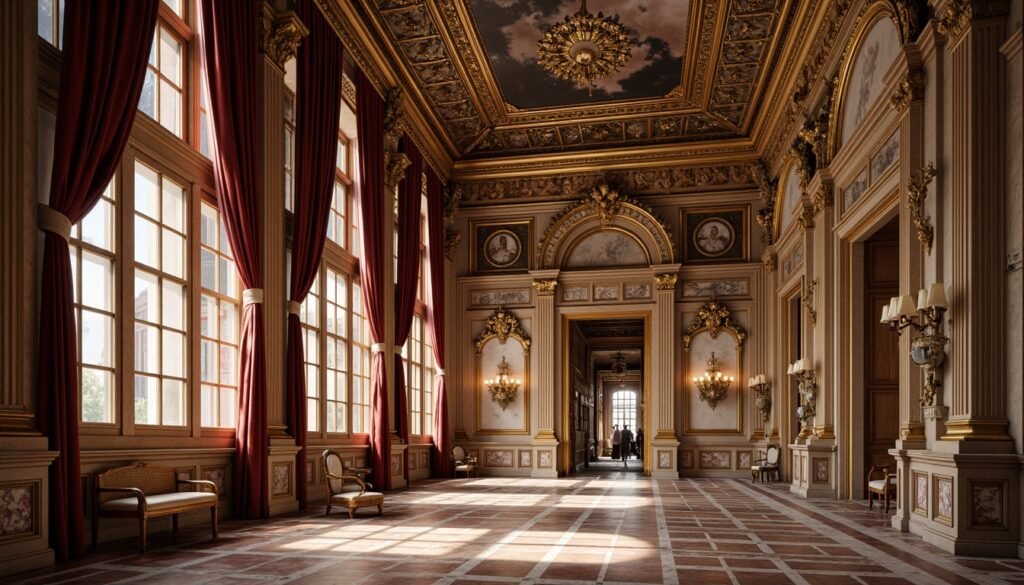
Inside, this axial thinking creates moments of drama: framed views, centered chandeliers, and focal artworks or fireplaces precisely aligned with the room’s geometry.
Central courtyards and grand halls
Many palaces employ:
- A central courtyard for light and ventilation.
- Grand stair halls and double-height reception spaces.
- Galleries for art and ceremonial processions.
These spaces are not arbitrary; they are carefully placed at key nodes in the circulation network, acting as both functional and symbolic centers.
Translating this to contemporary interior design in Bangladesh might mean:
- A central atrium in a commercial building.
- A double-height living space or lobby aligned with major circulation routes.
- A courtyard or lightwell that organizes rooms around it.
Hierarchy of spaces within palaces
One of the defining qualities of palace interiors is hierarchy. Not all rooms are equal; their height, ornament, and materials express their importance.
Typically:
- Public, ceremonial rooms: tall ceilings, rich finishes, abundant ornament.
- Semi-private rooms: refined but quieter detailing.
- Private quarters: more subdued, often warmer in material and scale.
For a modern interior design firm in chittagong or another city, this concept of hierarchy remains invaluable. It can guide decisions about where to invest in marble or intricate plasterwork, and where to keep surfaces calmer and more intimate.
Opulent palace interiors: materials and detailing
Renaissance Revival palace interiors are characterized by a rich but structured material palette. The opulence is not random; materials are layered with a clear sense of composition.
Use of marble, stone, timber, and plaster
Common elements include:
- Marble and stone: for flooring, staircases, columns, and sometimes wall dados.
- Fine timber: for doors, paneling, and parquet flooring.
- Plaster: for cornices, ceiling ornament, and sculptural relief.
The tactile quality of these materials contributes significantly to the atmosphere. Even in contemporary projects using modern substitutes, the idea of layered materiality—solid, weighty bases with refined upper treatments—can be maintained.
Ornamental ceilings, wall panels, and moldings
Ceilings in palace interiors often become canvases for both structure and ornament:
- Coffered ceilings with geometric patterns.
- Ornamental plaster or timber beams defining bays.
- Deep cornices transitioning between wall and ceiling.
Walls are usually articulated with:
- Paneling, pilasters, or engaged columns.
- Framed fields for paintings, mirrors, or textiles.
- Chair rails and dados providing visual grounding.
This language of defined zones and frames translates seamlessly into modern luxury interior design, allowing surfaces to be articulated without resorting to arbitrary decoration.
Frescoes, murals, and decorative artworks
Art is integral, not applied at the last moment. In Renaissance Revival palaces:
- Ceilings might feature allegorical paintings.
- Walls could hold large murals or framed artworks integrated into the architectural grid.
- Niches and overdoors might host sculpture or relief.
In a contemporary setting, one might replace allegorical frescoes with abstract art, photography, or subtle decorative painting, but the principle remains: art and architecture should be in dialogue, not in competition.
Furniture, decorative arts, and interior elements
The architectural framework sets the stage; furniture and decorative arts complete the composition.
Furniture proportions and placement
Renaissance Revival furniture tends to be:
- Solid, with clear geometric masses.
- Carefully proportioned to the architecture of the room.
- Positioned symmetrically around axes, fireplaces, or windows.
Even in modern interiors, symmetrical arrangements—pairing sofas, balancing side tables and lamps, aligning a dining table with a chandelier—create a sense of calm order that echoes historical interiors.
Textiles, tapestries, and drapery
Soft furnishings play a crucial role in modulating the formality of these interiors:
- Tapestries and upholstered wall panels add warmth and acoustic softness.
- Drapery frames windows and reinforces verticality.
- Rugs define functional zones within large rooms.
Choosing textiles with restrained pattern and rich texture can subtly evoke historical interiors without appearing theatrical.
Lighting fixtures and chandeliers
Chandeliers, wall sconces, and candelabra historically defined the luminous character of palace interiors:
- Central chandeliers aligned with room axes and ceiling ornament.
- Repetitive sconces reinforcing symmetry along corridors and galleries.
- Warm, layered lighting emphasizing material richness.
Today, crystal or metal chandeliers, combined with discreet architectural lighting, can continue the tradition of using light as both a functional and ceremonial element.
Craftsmanship and artisanal excellence
Renaissance Revival interiors are inseparable from the crafts that produced them. Joiners, plasterers, stone carvers, metalworkers, and painters each contributed to a unified whole.
Skilled workmanship
Details are often where the style is most evident:
- Hand-carved moldings and capitals.
- Precisely executed inlay in stone or timber.
- Finely detailed hardware on doors and furniture.
The precision of execution reinforces the overall sense of order and permanence.
Handcrafted detailing
Handwork introduces subtle variations—small irregularities that make surfaces feel alive rather than mechanical. Even when contemporary projects use CNC-machined components or prefabricated moldings, integrating some degree of manual finishing maintains this quality of refinement.
Importance of durability and legacy
Renaissance Revival palaces were designed to last, both structurally and aesthetically. Materials were chosen for longevity, and details were robust enough to withstand time.
For contemporary clients seeking long-term value, this is a useful perspective: investing in well-crafted, enduring elements—solid doors, quality stone, carefully detailed joinery—creates spaces that age gracefully rather than requiring frequent replacement. It is a mindset that a thoughtful interior design firm in chittagong, Dhaka, or abroad can adopt regardless of project scale.
Interior atmosphere and spatial experience
Beyond proportion and detail, Renaissance Revival interiors have a distinctive atmosphere: formal, but not cold; luxurious, but not frivolous.
Light, color, and material harmony
Daylight in historical interiors often entered through tall, symmetrically placed windows, grazing textured surfaces and picking up the depth of moldings and carvings. Colors tended to be layered:
- Stone and timber providing natural tones.
- Plasters and paints in muted, earthy hues or deep, saturated colors.
- Gold leaf or metallic accents used sparingly for emphasis.
Harmonizing light, color, and material creates interiors that feel composed at every time of day.
Formal yet inviting interiors
Formality in these spaces comes from order: aligned axes, disciplined ornament, consistent materials. Comfort arises from:
- Human-scaled furniture arrangements.
- Warm textures and textiles.
- Thoughtfully calibrated lighting.
This balance is particularly relevant for contemporary residences and hospitality projects, where people often desire a sense of ceremony in main spaces, paired with genuine comfort in daily use areas.
Balance between luxury and comfort
Luxury in Renaissance Revival interiors is rarely about excess. It is about:
- Quality of materials rather than quantity of decoration.
- Depth and precision of detailing.
- A sense that every element has been considered.
When applied intelligently, this approach allows even relatively modest spaces to feel dignified and composed, without imitating a palace in literal terms.
Influence on contemporary interior design
Renaissance Revival continues to inform how we design high-end homes, hotels, and institutional buildings. The influence is most successful when it is conceptual rather than purely stylistic.
Modern reinterpretation of Renaissance Revival principles
Today, designers often translate Renaissance ideas into:
- Clean-lined classical interiors with reduced ornament.
- Symmetrical layouts that structure open-plan spaces.
- Simplified moldings that reference classical profiles without heavy carving.
In Bangladesh and similar contexts, one might combine local materials and climate-responsive design with classical proportion and symmetry, achieving a dialogue between place and tradition.
Application in luxury residences, hospitality, and institutional projects
You can see echoes of Renaissance Revival in:
- Grand lobbies with axial layouts and central focal points.
- Hotel suites organized around balanced seating groups and framed views.
- Institutional interiors where corridors and galleries align with art and natural light.
These projects draw on Renaissance ideas about procession, hierarchy, and atmosphere, even when the aesthetic language appears contemporary.
Subtle adaptation rather than literal replication
The most timeless results come from adaptation:
- Using classical proportion systems to shape rooms, even if details are minimal.
- Introducing a few carefully crafted elements—an elegant cornice, a considered staircase, a framed ceiling—rather than recreating every historical motif.
- Allowing ornament to be quiet, supporting the overall calm of the space.
This approach respects history without turning interiors into stage sets.
Conclusion
Renaissance Revival design, with its emphasis on symmetry, proportion, and artisanal excellence, offers more than a historical style; it provides a coherent way of thinking about architecture and interiors. From palace interiors and grand halls to refined urban apartments and hotels, its core principles continue to yield spaces that feel both composed and deeply human.
In a world of rapidly changing trends, the enduring value of classical proportion and ordered composition remains evident. When rooms are shaped to human scale, when materials are chosen for their integrity, and when details are crafted with care, interiors acquire a quiet authority that does not depend on fashion. Whether interpreted richly or with restraint, the legacy of Renaissance architecture continues to guide designers who seek balance, harmony, and lasting beauty in the built environment.